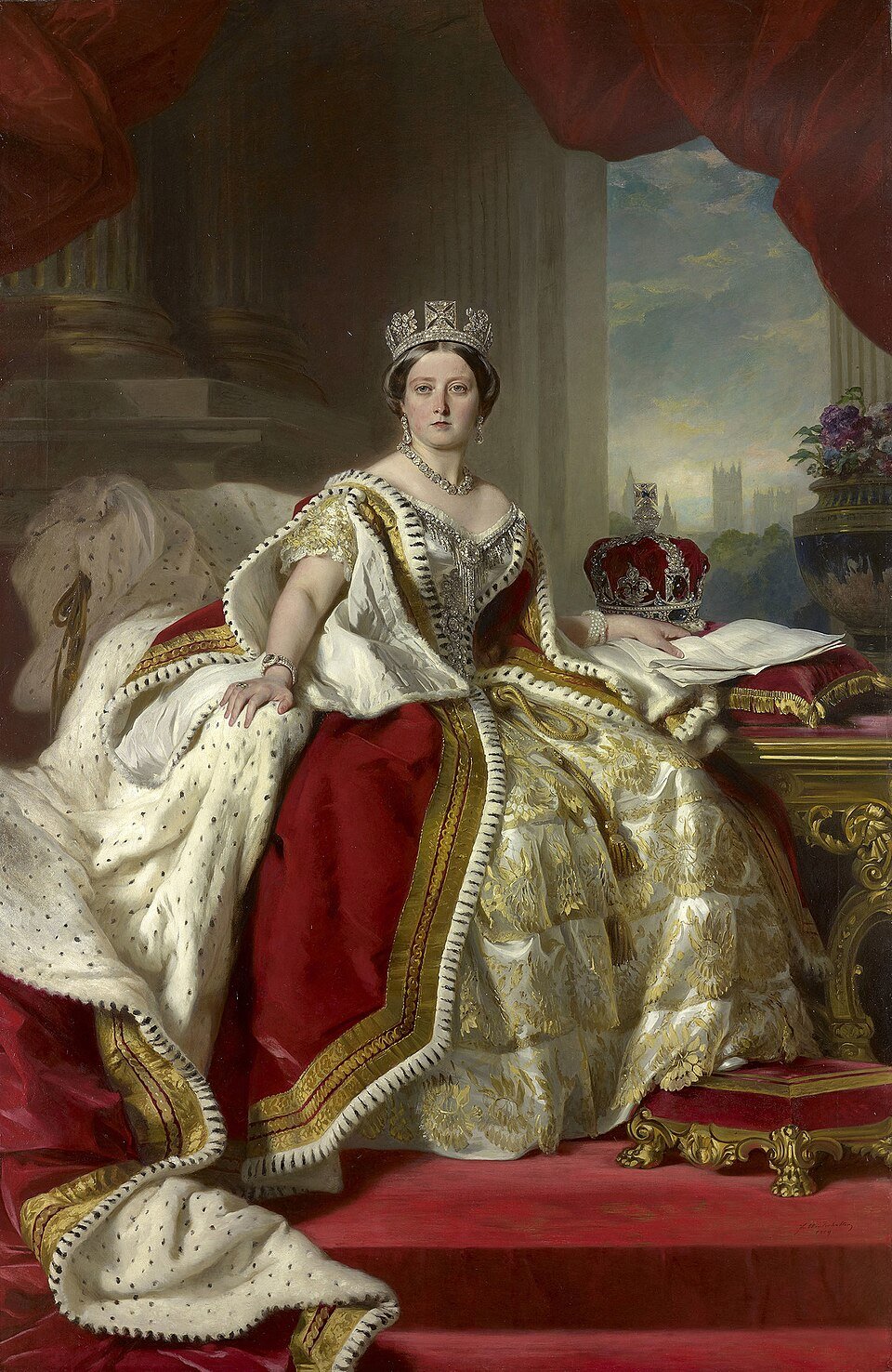
Overview
Victorian dress is where industry and clothing meet. Cheap machine-spun cloth, the sewing machine, paper patterns and the department store all arrive within a few decades, and the result is a century in which fashion changes faster than ever before and in which what a person wears reports their class with unusual precision.
Key garments and style
The women’s silhouette moves in identifiable phases: skirts widening over layers of petticoats, then over the cage crinoline of the 1850s and 1860s — a hooped frame that made enormous skirts light enough to walk in — then collapsing to the back into the bustle of the 1870s and 1880s, then the narrow line with leg-of-mutton sleeves of the 1890s. The corset is constant beneath all of them.
Men went the other way, into sobriety: the dark three-piece suit, the frock coat for day and the morning coat later, the top hat, and Savile Row establishing bespoke tailoring as an English institution.
Mourning dress was a system in itself, with prescribed fabrics and periods, and Victoria’s own long widowhood made it more elaborate.
Charles Frederick Worth, an Englishman working in Paris, effectively invented the couture house — showing collections on live models and signing garments as an author would.
Transition
The Edwardian S-bend gave way after 1914 to clothing that could be worked in, and the corset went with it.