Overview
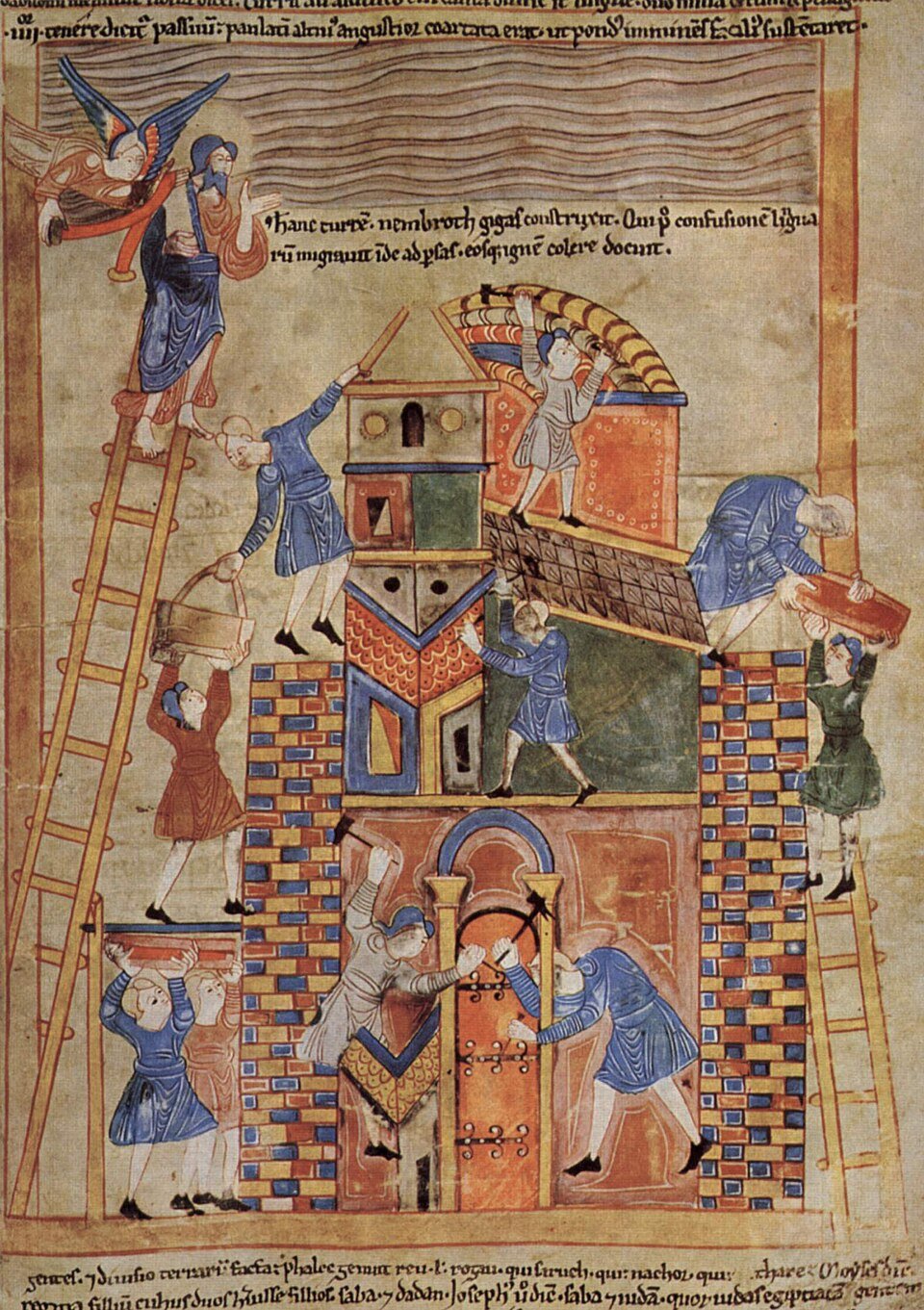
Two sources carry the whole picture and they cover different centuries. Furnished graves of the fifth to seventh centuries preserve the metalwork — brooches, pins, buckles, wrist clasps and the openwork girdle-hangers women wore at the hip — and the position of each object in the grave shows where the garment it fastened must have sat. Manuscripts take over from the tenth century, drawing contemporary English people into biblical scenes; the labourers on this page are building the Tower of Babel in the dress of the artist’s own time. Between the two lies a gap of three centuries with very little in it.
How it is worn
A man wore a tunic to the knee, pulled over the head and belted at the waist, with the sleeves close at the wrist. Below it went hose or separate leg coverings, often cross-gartered with strips wound up the calf, and over it a rectangular cloak pinned at one shoulder so the sword arm stayed free. Early women’s dress was a tubular gown held up by a brooch on each shoulder, an arrangement that needs no cutting and leaves the pair of brooches sitting in the grave where the collarbones were. From the seventh century that gives way to a sleeved gown worn with an under-dress, a belt, and a head-cloth covering the hair, and the paired shoulder brooches disappear with it.
History
The change is a change of religion as much as of fashion. Conversion brought the veiled, sleeved, fully covered silhouette that the rest of Christian Europe wore, and it brought the end of furnished burial — which is why the archaeological record thins just as the manuscript record has not yet begun. Colour was available and used: madder, weld and woad gave red, yellow and blue, and the tablet-woven braids that edged garments were worked in silk and sometimes gold. After 1066 English dress is folded into the continental fashion of the Norman court, and the tunic-and-hose set survives as working clothes rather than as anyone’s best.