Overview
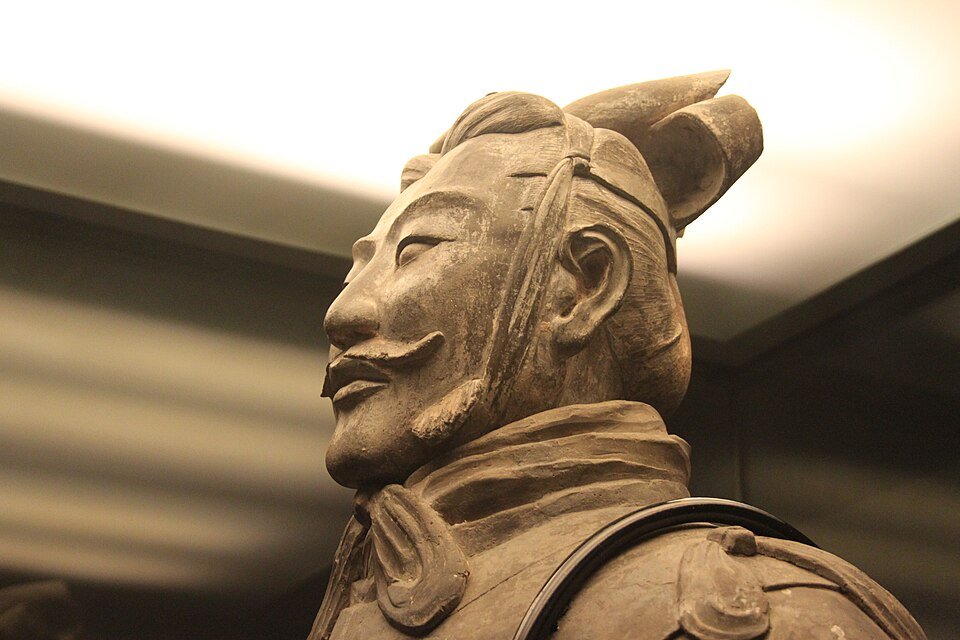
The Qin lasted fifteen years and left the single most detailed record of ancient Chinese clothing that exists. The Terracotta Army was not made to record dress, but it does: thousands of life-size figures, individually finished, wearing what the Qin army wore, down to the tie of a sash and the lacing of a plate of armour.
Key garments and style
The soldiers wear a cross-collar robe closing to the right — the fold that stays standard in Chinese dress for two thousand years — over trousers, belted with a hooked buckle. Armour is lamellar: small plates laced in overlapping rows, cut differently for infantry, cavalry, archers and charioteers, and absent altogether on some ranks. Rank reads from headgear and armour rather than from insignia, with officers in caps and ordinary soldiers in topknots or cloth wraps.
The figures were painted, and traces survive: purples, reds, greens and blues, so the army was originally as vivid as it is now uniformly grey. The pigment includes Han purple, a synthetic barium copper silicate not otherwise known outside China.
Two things about the dynasty itself belong here. Black was the honoured court colour, chosen from the Five Elements cosmology that assigned each dynasty a phase; and dress and measures were standardised alongside script, coinage and axle width.
Transition
The Han inherited the Qin forms and elaborated them into the robes now generally called hanfu, keeping the right-over-left crossing as the mark of a Chinese garment.