Overview
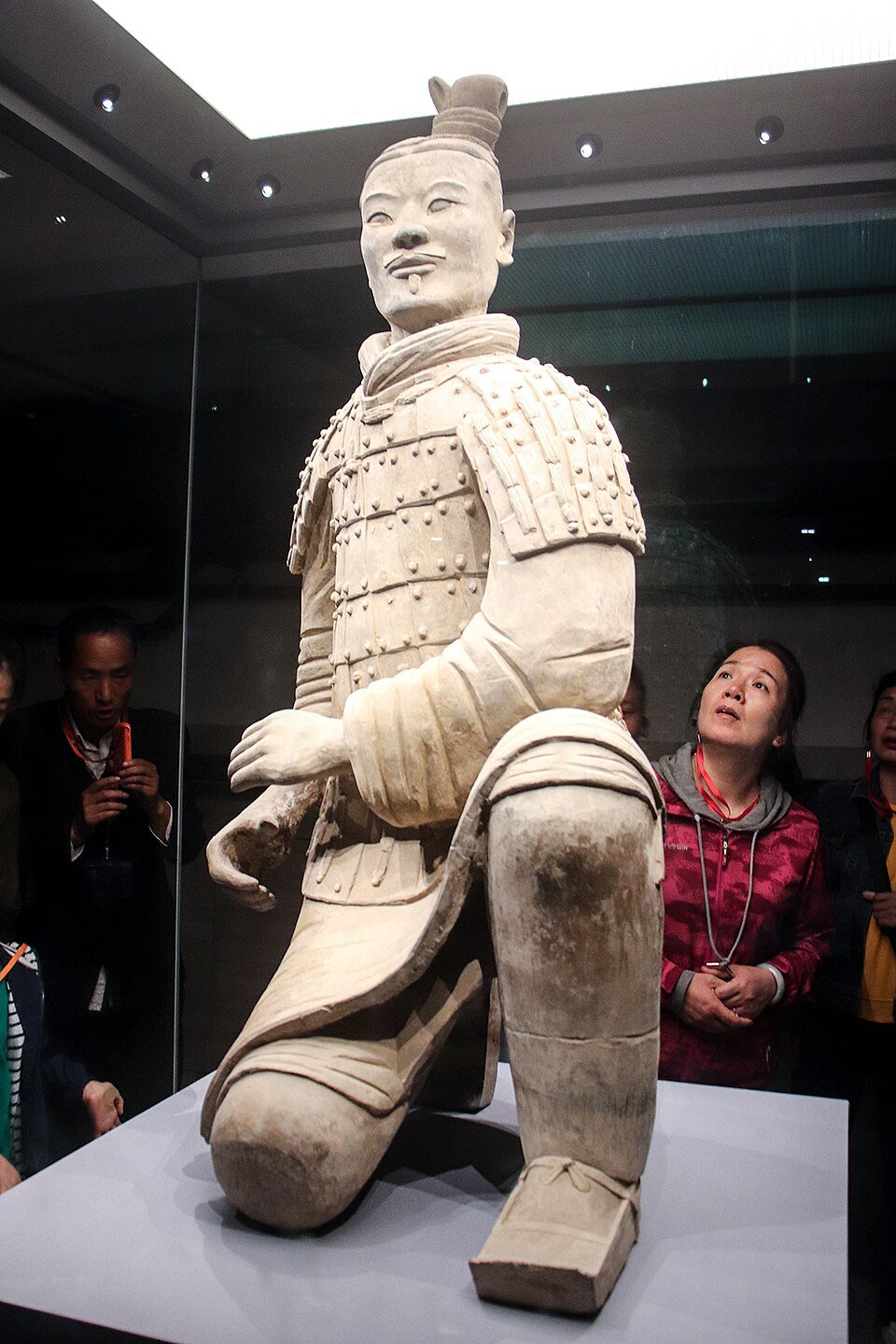
The terracotta army is the reason. Every figure was modelled individually and finished in colour, and although most of the pigment has gone the modelling has not: collars, belt hooks, armour lacing, shoe soles and hair are all rendered at full size. What they show is the same yi-shang principle the Shang and Zhou used, tightened. The robe crosses at the chest with the right panel underneath, reaches the knee or lower, and is held by a belt fastened with a cast hook rather than tied. Trousers are worn beneath it — not a Chinese habit originally, but a cavalry one adopted from the northern steppe.
How it is worn
A soldier’s robe is put on first and the armour goes over it, a waistcoat of small lacquered plates laced together with cord, hanging to the hips with separate shoulder pieces. Below, the trousers are bound at the calf and the shoes are square-toed with a thick sole, tied over the instep. The hair is the giveaway of rank and unit: gathered up into a topknot set to one side and bound with cord, or covered by a flat cap, and the pattern of the knot differs between infantry, archers and officers. Officials outside the army wore the same robe cut longer, without the armour, with a cap whose form marked their office.
History
Qin ruled by standardising: the script, the axle width of carts, the weights and the coinage. Dress was standardised too, and the colour chosen was black — the dynasty claimed the element water, whose colour is black, and dressed its court accordingly. Fifteen years later the dynasty was gone, but the Han inherited the robe unchanged in cut and kept it for four centuries, which is why the Qin figures read less as a curiosity than as the first clear photograph of a garment that was already old and would last a great deal longer.