Overview
Karnak is a huge complex of temples at Thebes, on the site of modern Luxor, and was the chief sanctuary of the god Amun-Ra. Construction spanned roughly two thousand years, from Senusret I in the Middle Kingdom into the Ptolemaic era, with nearly every major pharaoh adding courts, pylons or obelisks.
Description
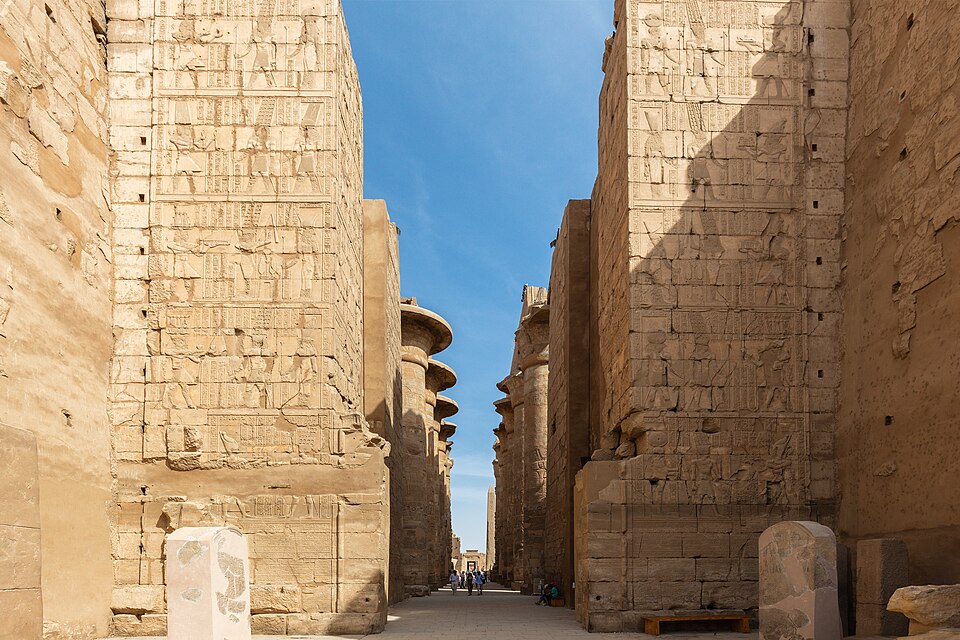
Its most celebrated part is the Great Hypostyle Hall, raised chiefly under Seti I and Ramesses II, where 134 columns up to around 21 metres tall crowd into some 5,000 square metres. One of Hatshepsut’s obelisks still stands within the precinct, and an avenue of sphinxes links Karnak to Luxor Temple.
History and legacy
Karnak is often described as the largest religious complex of the ancient world, a record in stone of two millennia of royal building. In 1979 it was inscribed on the UNESCO World Heritage List as part of Ancient Thebes.