Overview
The era opens with Alexander the Great’s conquest in 332 BC and the founding of Alexandria in 331 BC. After Alexander’s death in 323 BC his general Ptolemy took Egypt as satrap, secured Alexander’s body for burial there rather than in Macedon, and declared himself King Ptolemy I Soter in 305 BC.
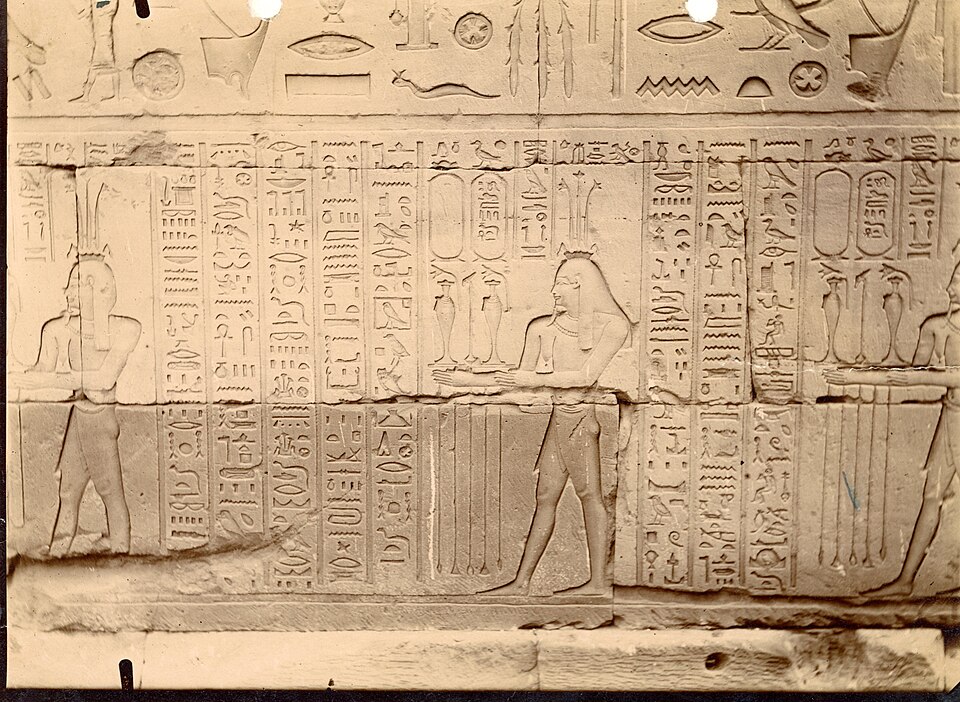
The dynasty that followed ruled for nearly three centuries as Macedonian kings and Egyptian pharaohs at once, keeping Greek as the language of government while building and endowing Egyptian temples at Edfu, Dendera, Philae and Kom Ombo. Ptolemy I promoted the cult of Serapis, a god assembled to be legible to Greeks and Egyptians alike — the clearest single statement of how the family meant to rule.
Key developments
Alexandria became the Mediterranean’s leading city of learning and trade. Its Library and Mouseion, endowed under Ptolemy I and Ptolemy II Philadelphus, drew Euclid, Eratosthenes, who measured the circumference of the earth, and Herophilus, who dissected the human body; the Septuagint, the Greek translation of the Hebrew scriptures, was made in the city, by tradition under Ptolemy II. The Pharos lighthouse, built for the harbour by Sostratus of Cnidus, was counted among the Seven Wonders of the Ancient World.
Behind the scholarship was a tightly run royal economy — grain exported across the Mediterranean, land reclaimed in the Fayum, crown monopolies on oil and other staples — recorded in thousands of surviving papyri that make this the best-documented stretch of ancient Egyptian administration. Its limits showed after 217 BC, when Ptolemy IV won the battle of Raphia by arming native Egyptian troops. Within a decade Upper Egypt was in revolt under rebel pharaohs of its own, and it took until 186 BC to put down. The Rosetta Stone, a priestly decree for Ptolemy V issued in 196 BC, belongs to that settlement; its three scripts later gave Champollion the key to hieroglyphs.
End and transition
The later dynasty was consumed by fratricidal succession disputes and increasingly settled them through Rome. In 168 BC the Roman envoy Popillius Laenas drew a circle in the sand around Antiochus IV and demanded his answer before he stepped out of it; Antiochus withdrew from Egypt, and the kingdom survived thereafter at Rome’s discretion.
Cleopatra VII, reportedly the first of the line to learn Egyptian, staked the throne on Caesar and then on Antony. Defeat at Actium in 31 BC and her death the following year ended the dynasty: Egypt was annexed as a personal province of Augustus, governed by a prefect and closed to senators, and its grain fed Rome for the next three centuries.