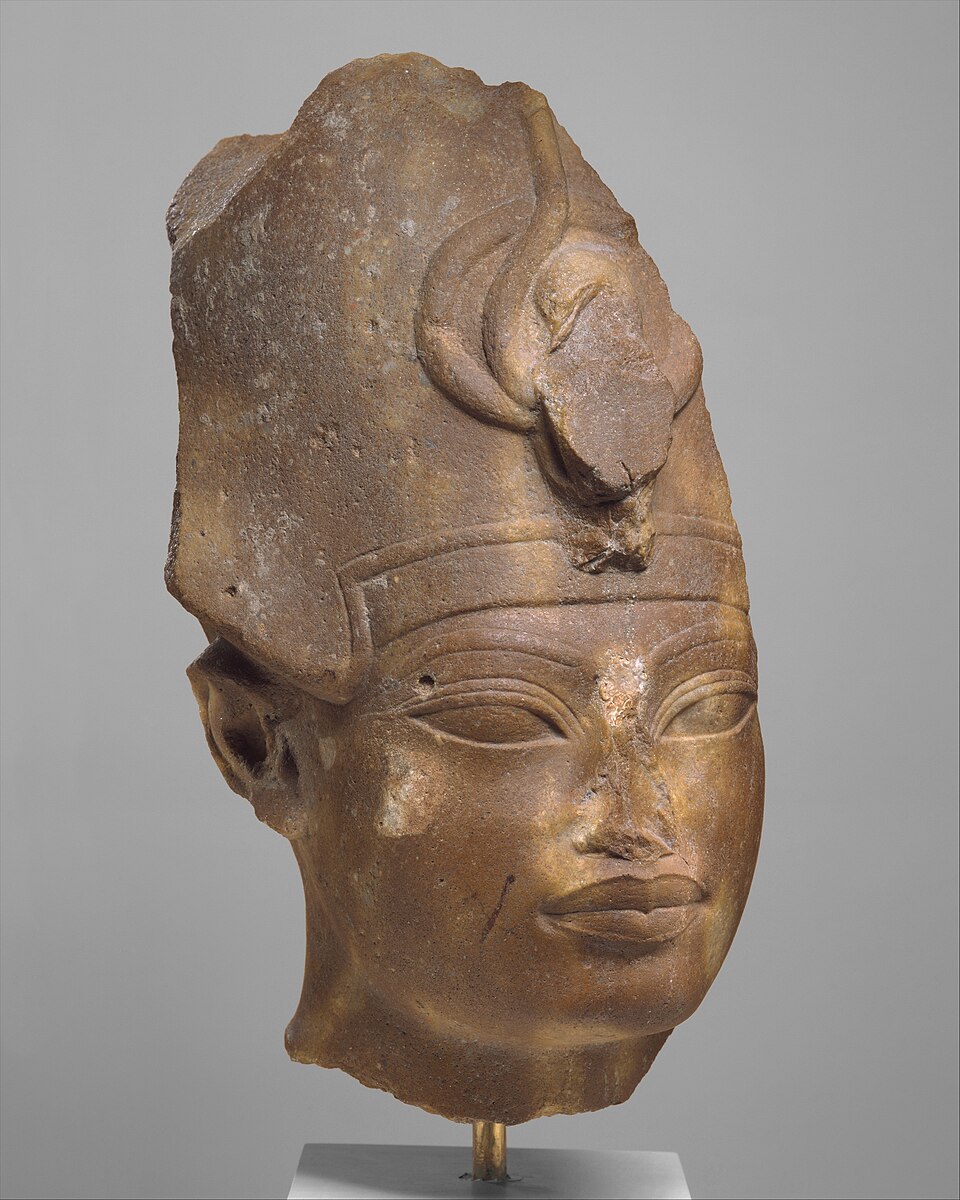
Overview
It is a high, bulbous headdress that rises and curves back from a straight browband, its whole surface covered with small circles — usually read as discs of metal or as an imitation of a leather ground — and coloured blue in every painted example. The uraeus, the cobra, sits at the front. No physical khepresh has ever been found: everything known about it comes from relief, statuary and painting, which is why its material is argued about and its shape is not.
How it is worn
It is worn alone, over a shaven head or a close cap, with the browband level and the cobra centred, and it appears on kings in chariots, kings offering to gods, and kings shown as living rulers rather than as the dead. Because it belongs to the living king it never appears on a funerary mask; the nemes headcloth does that work instead. The crown is also small in the record before the Eighteenth Dynasty and everywhere in it afterwards.
History
It appears in the Second Intermediate Period and becomes a standard royal headdress in the New Kingdom, where Amenhotep III, Akhenaten and above all Ramesses II are shown in it constantly — the battle reliefs at Abu Simbel and the Ramesseum put it on the king in his chariot at Kadesh. The war-crown reading comes from those scenes and from nineteenth-century Egyptology; current work treats it more cautiously, as a crown of the king in action, whether that action is a battle or a rite.