What happened
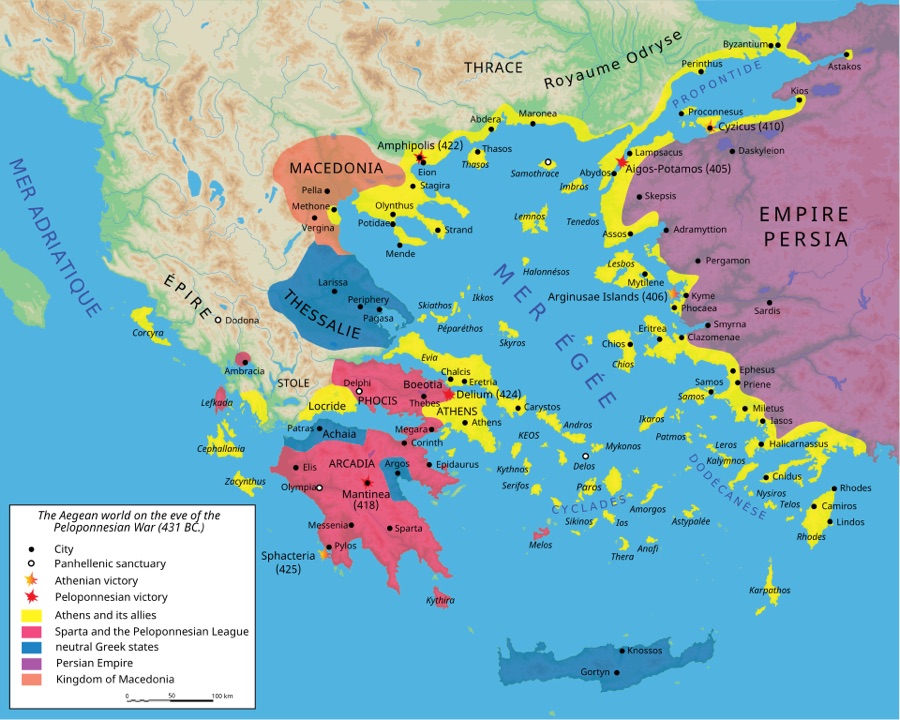
In the first phase (431–421 BC), Sparta invaded Attica almost yearly while Athens raided by sea. The plague of Athens (430–426 BC) killed perhaps a quarter to a third of the population, Pericles among the dead, before the uneasy Peace of Nicias in 421. The Sicilian expedition of 415–413 BC — Athens’ vast armada sent against Syracuse — ended in total destruction, the war’s great catastrophe, with the defections of Alcibiades an episode along the way. In the final phase (413–404 BC), Sparta built a fleet funded by Persian gold in exchange for conceding the Asian Greeks, and Athens’ fleet was annihilated at Aegospotami in 405. Besieged and starved, Athens surrendered in 404: its walls were pulled down, its empire was gone, and a Spartan-backed oligarchy, the Thirty Tyrants, was briefly imposed (democracy was restored in 403).
Background
The war set Athens and its empire against Sparta and the Peloponnesian League. It was chronicled by Thucydides, whose famous judgment — that the war was made inevitable by the growth of Athenian power and the fear it inspired in Sparta — founded political realism.
Consequences
Atrocities on both sides, Melos among the notorious cases, hardened the conduct of war; Thucydides framed them in his set-pieces on power and justice. The war left the polis world exhausted and made Persia the arbiter of Greek affairs. Sparta’s supremacy proved short, and two generations later the way lay open for Macedon.