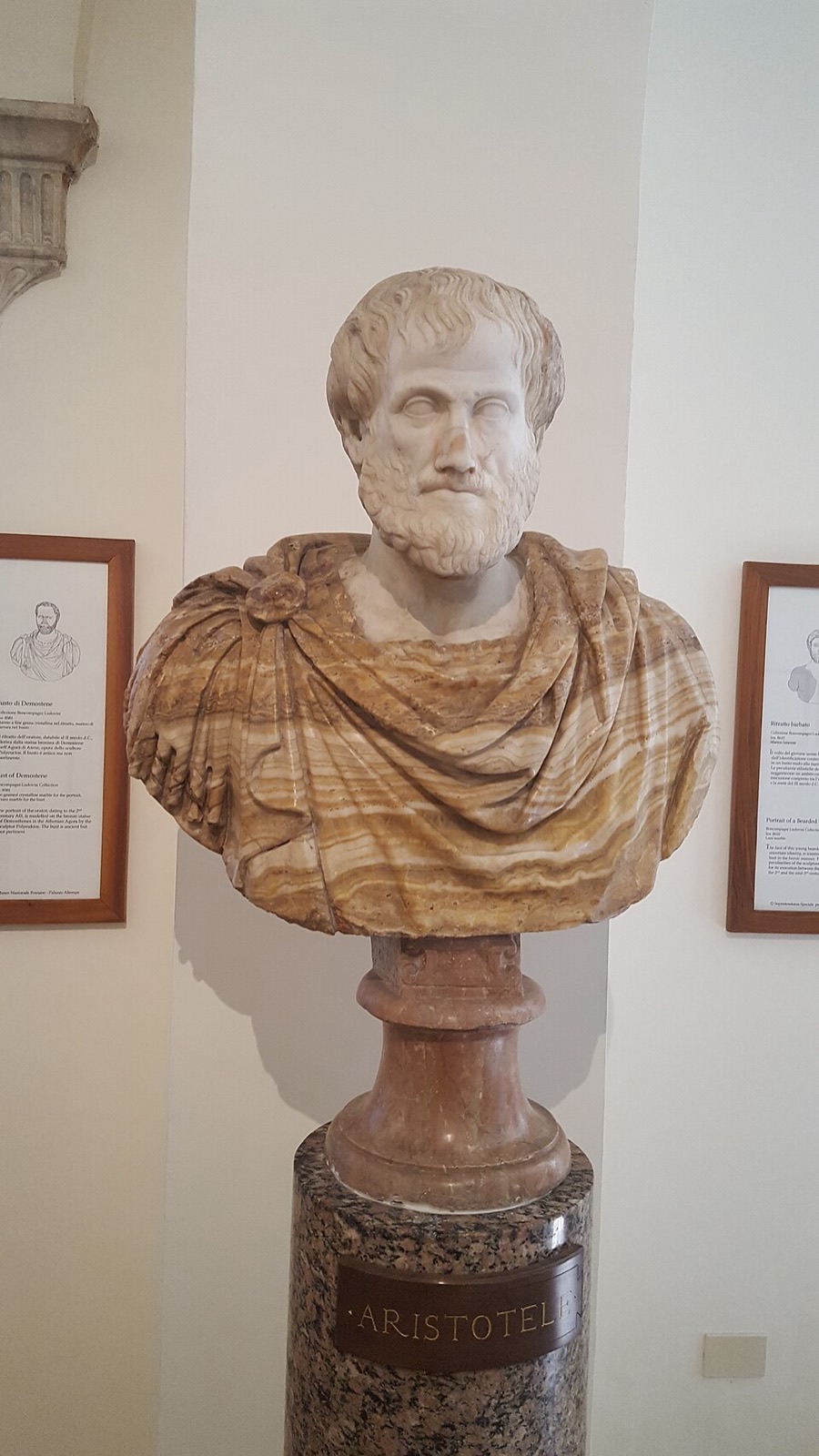
Who they were
Aristotle was born in 384 BC at Stagira in the north, the son of the Macedonian court physician. He spent twenty years in Plato’s Academy, tutored the young Alexander the Great around 343 BC, and in 335 BC founded his own school in Athens, the Lyceum — home of the Peripatetics. After Alexander’s death in 323 BC, anti-Macedonian Athens charged him with impiety; he left the city — reportedly so that Athens would not sin against philosophy a second time — and died at Chalcis in 322 BC.
What they did
He was the great systematizer: logic (the syllogism, the first formal logic), physics, biology, metaphysics, ethics (virtue as a habituated mean, aiming at eudaimonia), politics (constitutions collected and compared), rhetoric, and poetics (tragedy’s catharsis). His dissections and marine observations, notably in a lagoon on Lesbos, are said to have earned the praise of modern biologists for their lasting quality. His method was to start from observation and common opinions, and he saw nature as teleological — purpose-driven — a view enormously fruitful and, in physics, an enormously long-lived error. What survives are largely lecture texts edited later; his polished dialogues are lost.
Legacy
For two millennia Aristotle was the dominant intellectual authority of the Islamic and Christian worlds — to the scholastics he was simply the Philosopher, without further name. He stands as the founder of disciplines from logic to biology to literary criticism.