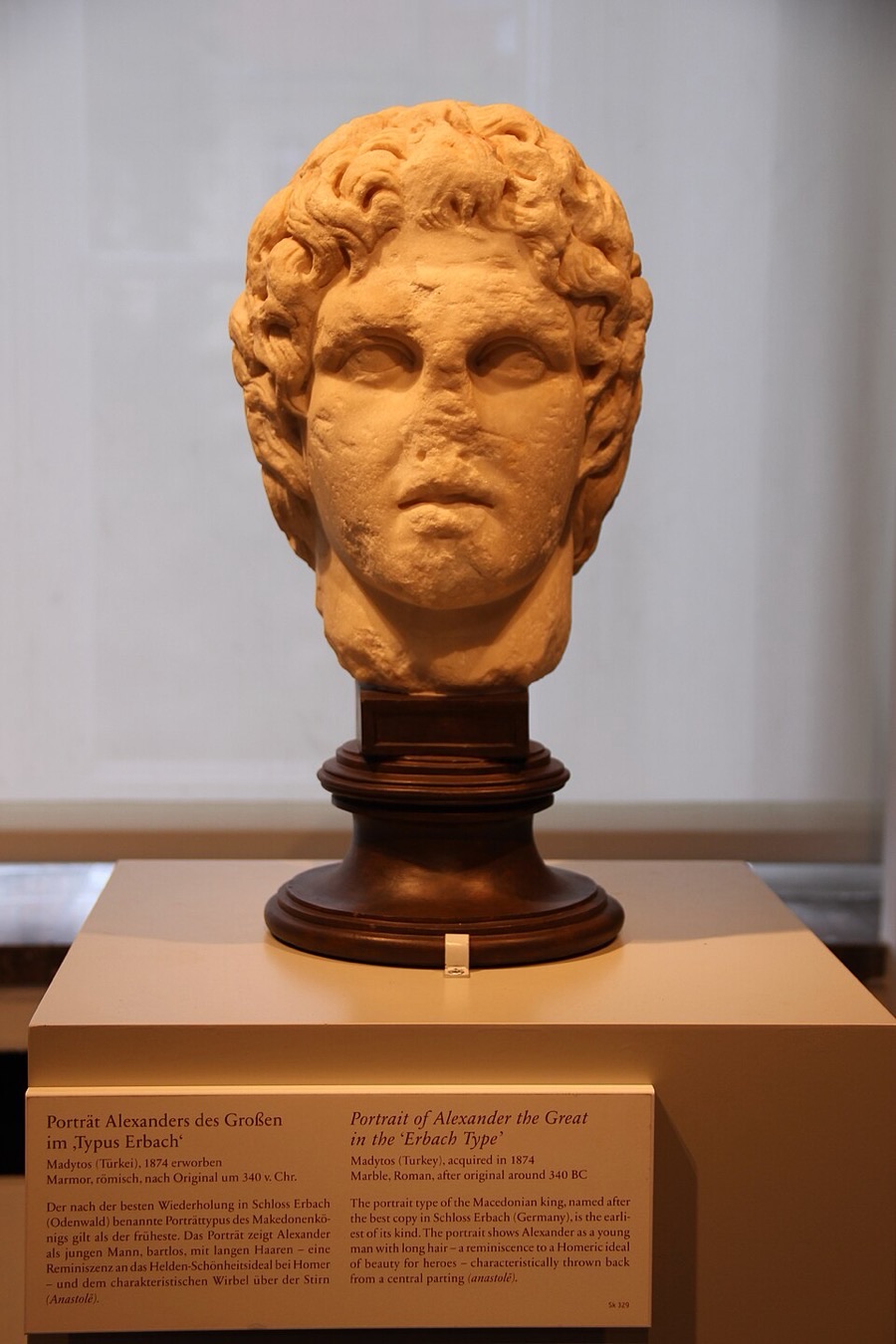
Who they were
Alexander was born in 356 BC to Philip II of Macedon and Olympias. His father’s reformed army and mastery of Greece, sealed at Chaeronea in 338 BC, gave him his platform, and from c. 343 BC he was tutored by Aristotle at Mieza. When Philip was assassinated in 336 BC, Alexander took the throne at twenty, crushed the revolts that followed, and in 335 BC razed rebellious Thebes as a warning to Greece.
What they did
In eleven years he conquered the Persian Empire and beyond, from the Aegean to Egypt — where he founded Alexandria — and on to the Indus — generally regarded as undefeated in battle. He turned back at the Hyphasis river in India in the autumn of 326 BC, when his army refused to go further, and the march home through the Gedrosian desert cost many lives. As ruler he adopted Persian court forms and mixed-elite policies such as the mass weddings at Susa, provoking Macedonian resentment. The record has its dark side: he killed his officer Cleitus in a drunken rage and had the historian Callisthenes executed. He died at Babylon in June 323 BC, just short of 33 — fever and poison theories alike remain unprovable.
Legacy
His empire fragmented immediately among his generals, the Successors, producing the Hellenistic kingdoms. The conquests spread the Greek language and Greek culture across western Asia and Egypt, creating the Hellenistic world with koine Greek as its common tongue. Often called the greatest commander in history, he has been studied as a military model ever since. He became a legend in dozens of cultures, from the Alexander Romance to Iskandar of Persian epic. Assessments still split between the visionary unifier and the destroyer.