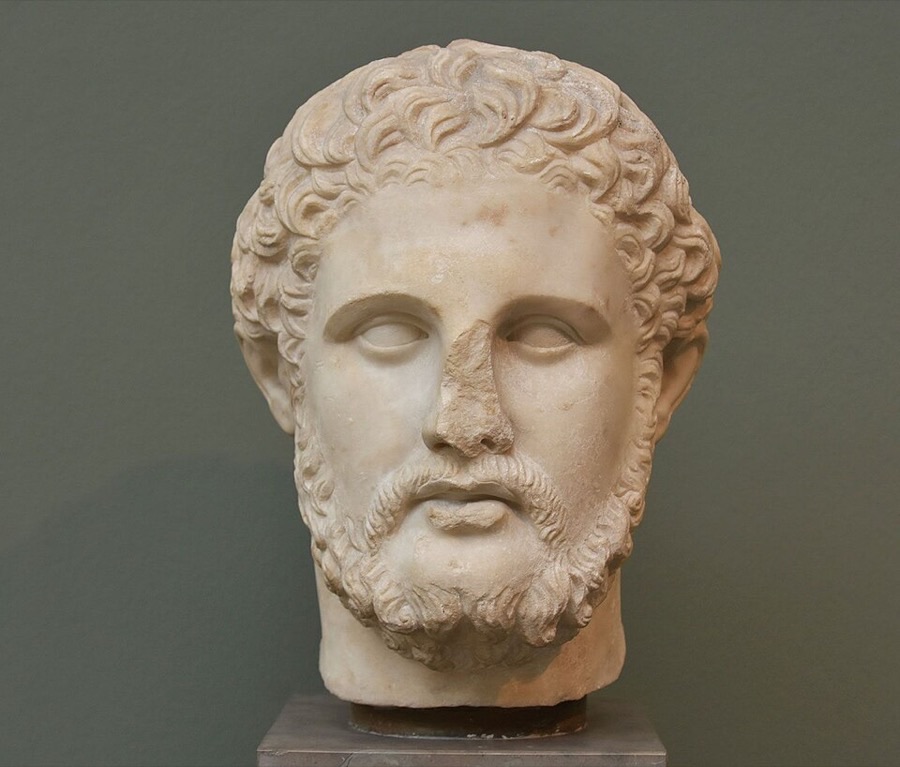
Who they were
Philip II (382–336 BC, r. 359–336 BC) inherited a Macedon in collapse — his brother had just been killed, with 4,000 men, by the Illyrians — and made it the master of Greece in a generation. He lost an eye at the siege of Methone. His statecraft ran to diplomacy, bribery, and seven political marriages; the quip attributed to him, that any city could be taken by a donkey laden with gold, became proverbial.
What they did
He re-made the army: the sarissa-armed phalanx, combined arms with the Companion cavalry, professional year-round training, and siegecraft — the army Alexander would inherit — funded by the gold mines he seized near Philippi. He expanded through Thessaly and Thrace and entered central Greece through the Sacred Wars, while Demosthenes’ Philippics rallied Athens against him — the word survives. At Chaeronea in 338 BC he defeated Athens and Thebes, his 18-year-old son Alexander leading the decisive cavalry charge; in 337 BC he founded the League of Corinth, uniting Greece under his hegemony and voting a war of revenge on Persia, whose advance force crossed in 336 BC. That year he was assassinated at his daughter’s wedding at Aigai by his bodyguard Pausanias of Orestis; theories that Olympias, Alexander, or Persia instigated the deed remain speculation.
Legacy
The royal tombs found at Vergina in 1977 are widely linked to him, though the attribution of Tomb II is debated. Philip is often called the underrated architect of Alexander’s conquests — the builder of the instrument his son wielded.