Overview
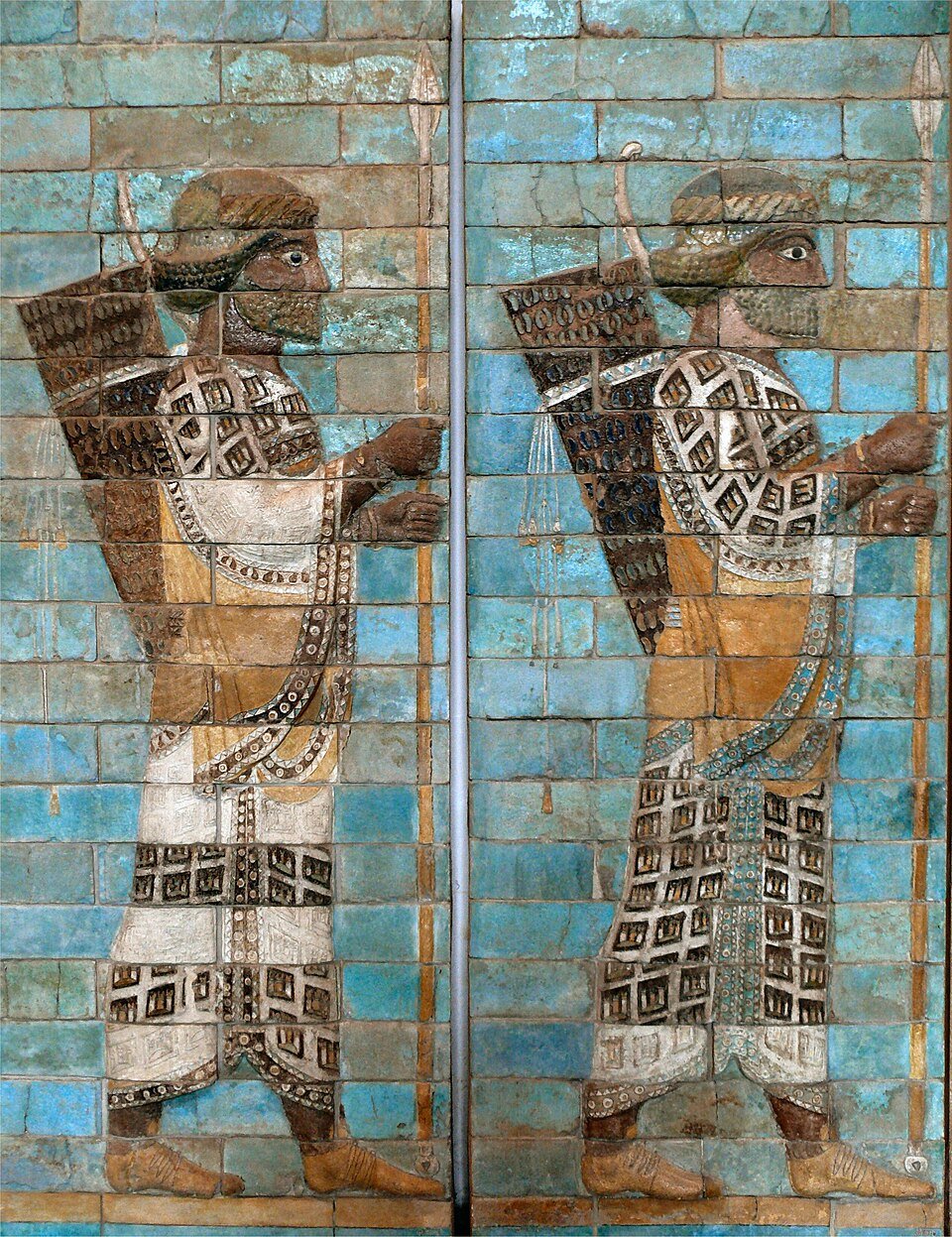
The Achaemenids ran an empire of many peoples and dressed to say so. Their court used two distinct wardrobes side by side — a ceremonial Persian robe and the trousered Median riding dress — and their monumental art shows subject nations each in their own clothing, so dress became a way of picturing the empire’s composition.
Key garments and style
The Persian court robe is a wide garment with full sleeves, arranged in deep vertical pleats and belted, worn with a fluted cap; on the Persepolis reliefs it falls in the regular folds that identify the wearer as Persian at court. Against it sits the Median outfit: trousers, a sleeved tunic, a coat and a round felt cap, with the short akinakes dagger — practical clothing for riding and war, and worn by Persians as well as Medes.
The Apadana staircase reliefs are the fullest visual record, with delegations from across the empire carved in their own dress and bringing their own goods. Textiles themselves were an instrument of rule: robes of honour were given by the king, and Greek writers describe Persian court dress as a spectacle of dyed and gold-worked cloth.
To Greek eyes the whole thing reduced to one detail — trousers — which became shorthand for the East and stayed so for centuries.
Transition
Alexander’s conquest put Greek dress at the top of the plateau, and the Seleucids ruled for two centuries without their subjects’ clothing following theirs.