Overview
The eighteenth century in Iran was a long interruption: the Safavid collapse, the Afghan invasion, Nader Shah’s campaigns and then civil war. Dress did not change much, and the reason is worth stating — the court style of the Safavids had been an achievement of settled workshops, and what these decades mostly did was damage the workshops rather than replace the style.
Key garments and style
The male ensemble stayed Safavid in outline: a long coat over a shirt and trousers, closed with a sash wound at the waist, with a turban on the head. Silk, brocade and figured velvet remained the materials of rank, and the Zand court at Shiraz under Karim Khan is remembered as a period of comparative ease in which the older luxury was sustained.
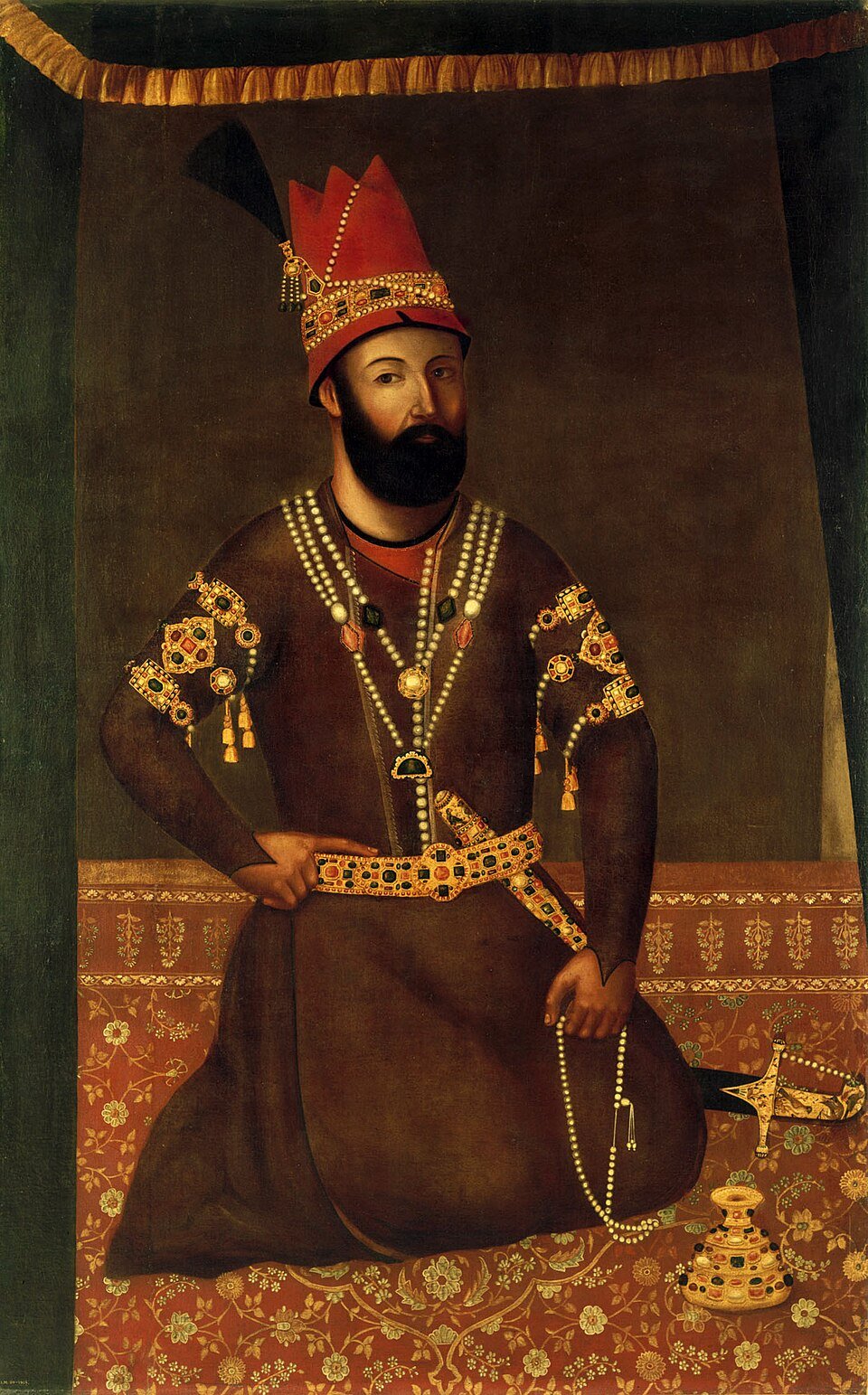
Headgear is where the period signs itself. Nader Shah is consistently shown in a tall, distinctive four-peaked cap, and it is one of the few genuinely new forms of these decades — a personal emblem of a soldier-ruler rather than a court fashion that spread.
Two cautions. Isfahan’s weaving establishment, the engine of Safavid textile splendour, never recovered from the sack of 1722, so later silks of this quality are often older cloth still in use. And much of what is pictured comes from Zand-period painting, which was itself reviving Safavid conventions, so the images may be more conservative than the streets were.
Transition
The Qajars replaced the turban with the tall black lambskin hat and built a court style around it, giving nineteenth-century Iran a silhouette immediately distinguishable from this one.