Overview
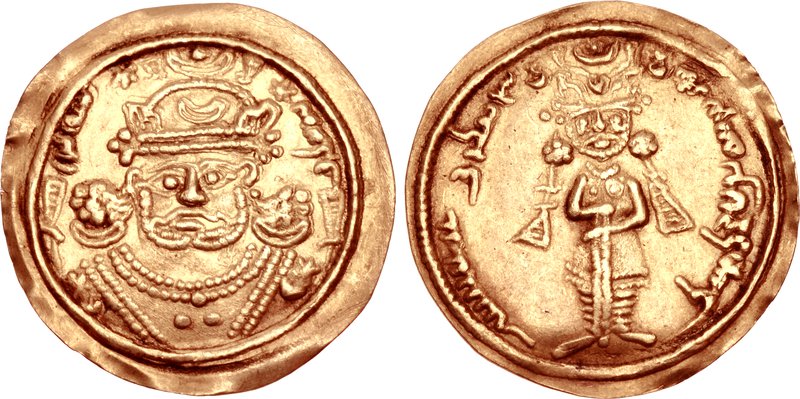
The crown is a composite: a jewelled circlet, a set of emblems chosen by the king — crescent, wings, eagle’s head, stepped merlons, rays — and above it the korymbos, a sphere far too large to be a hat, understood as the king’s bound hair inside silk. Coins, rock reliefs and silver plates show the same combinations consistently enough that a numismatist can order the dynasty by them, and the practice is unusually literal: a new king means a new crown, not a variation on his father’s.
How it is worn
It was not carried on the head all the time. The largest crowns were suspended above the throne by a chain and the king sat beneath them, which several sources report and the sheer weight of the goldwork makes plausible; what the coins show is the ceremonial arrangement rather than daily wear. The emblems are read as claims — wings for the god Verethragna, crescent for the moon, rays for divine glory — and the whole is set on hair dressed to fill the veil above it.
History
The design outlived the empire. Sasanian crown types are copied on early Islamic coinage, on Central Asian rulers’ portraits and in Byzantine imagery of eastern kings, and the korymbos survives in Persian painting long after anyone had seen one. It became the shorthand for kingship in the region — an emblem legible at coin scale, which is exactly what a dynasty minting silver for four centuries needed.