Overview
Sasanian dress is unusually well recorded for an ancient empire, because the same court style was cut into cliff reliefs, hammered into silver plates, struck on coins, and woven into silks that were exported and then preserved abroad. Its reach was wider than the empire’s. Sasanian pattern and Sasanian tailoring were copied in Byzantium, in Sogdiana and in Tang China, and much of what survives is preserved nowhere near Iran — Sasanian and Sasanian-style silks kept as relic wrappings in European church treasuries, and the roundel design carried as far east as the Horyuji and Shosoin collections in Japan.
Key garments and style
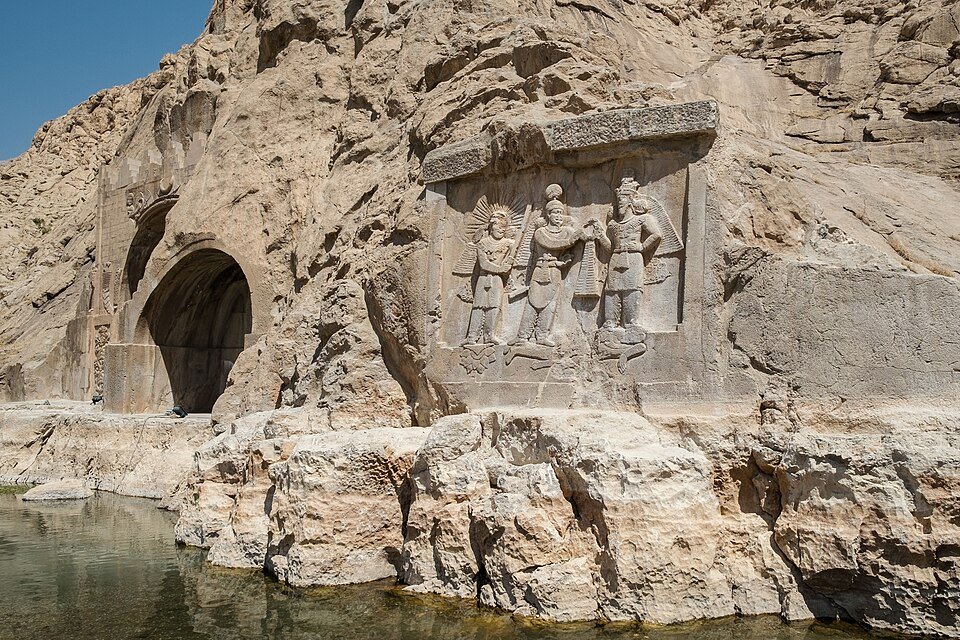
The court silhouette was fitted rather than draped: a long-sleeved tunic over wide trousers, gathered at the waist and shown billowing at the ankle, with an open-fronted caftan over it and soft boots tied at the instep. Fluttering ribbons — at the crown, at the shoulder, at the shoe — are the signature the Sasanians attached to everything, and they mark a figure as royal in any medium.
Each king wore a personally distinctive crown topped by the korymbos, a bound mass of hair covered in silk, which is why rulers can be identified on coins even where no legend survives. The silks carried repeating roundels bordered with pearls, enclosing the senmurv, the winged horse, the boar’s head or the ram: a pattern system compact enough to be copied by any weaver anywhere, which is precisely what happened to it. The great iwan at Taq-e Bostan, where Khosrow II hunts in a densely patterned coat, is the fullest single record of the whole ensemble.
Transition
The Arab conquest ended the dynasty in 651 and did not end the style. Sasanian weavers, motifs and cuts passed into Umayyad and Abbasid court dress and into the tiraz workshops that clothed it, and the pearl-roundel silk remained the luxury textile of western Asia for centuries after the empire that invented it had gone.