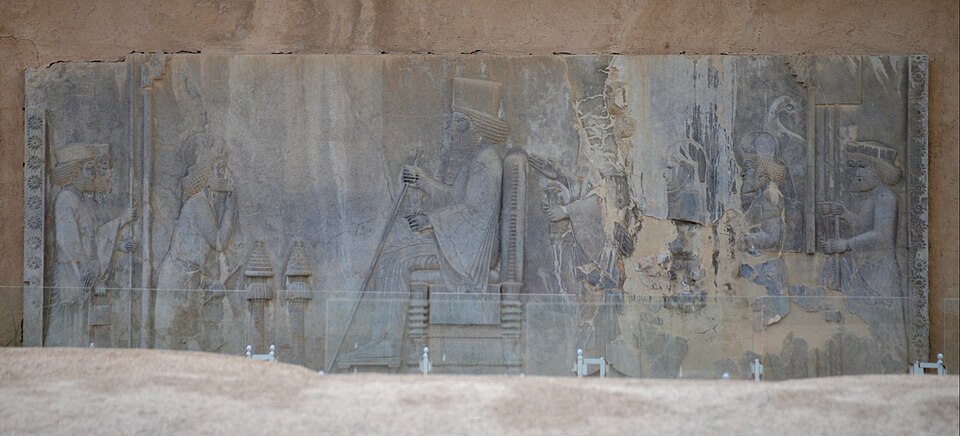
Who they were
Darius took the throne amid crisis after the death of Cambyses II, defeating rebellions across the empire. His own account of those events, carved with reliefs high on the Behistun rock in Old Persian, Elamite, and Babylonian, doubles as the key that let scholars decipher cuneiform in the 19th century.
What they did
Darius was the great organizer: he divided the empire into satrapies with fixed tribute, standardized weights and the gold daric, built the Royal Road, and — as his inscriptions attest — completed a canal linking the Nile to the Red Sea. Around 518 BC he began Persepolis as the ceremonial capital. He expanded the empire to its greatest extent, campaigning to the Indus and into Europe, taking Thrace and receiving Macedonia’s submission, though a Scythian expedition beyond the Danube achieved little. After the Ionian Greek revolt of 499–493 BC, his punitive expedition against Athens was defeated at Marathon in 490 BC — a limited defeat for the empire, but a foundational memory for Greece.
Legacy
Darius died in 486 BC while preparing a renewed campaign against Greece, and his son Xerxes I succeeded him. He was buried in a rock-cut tomb at Naqsh-e Rostam.