Overview
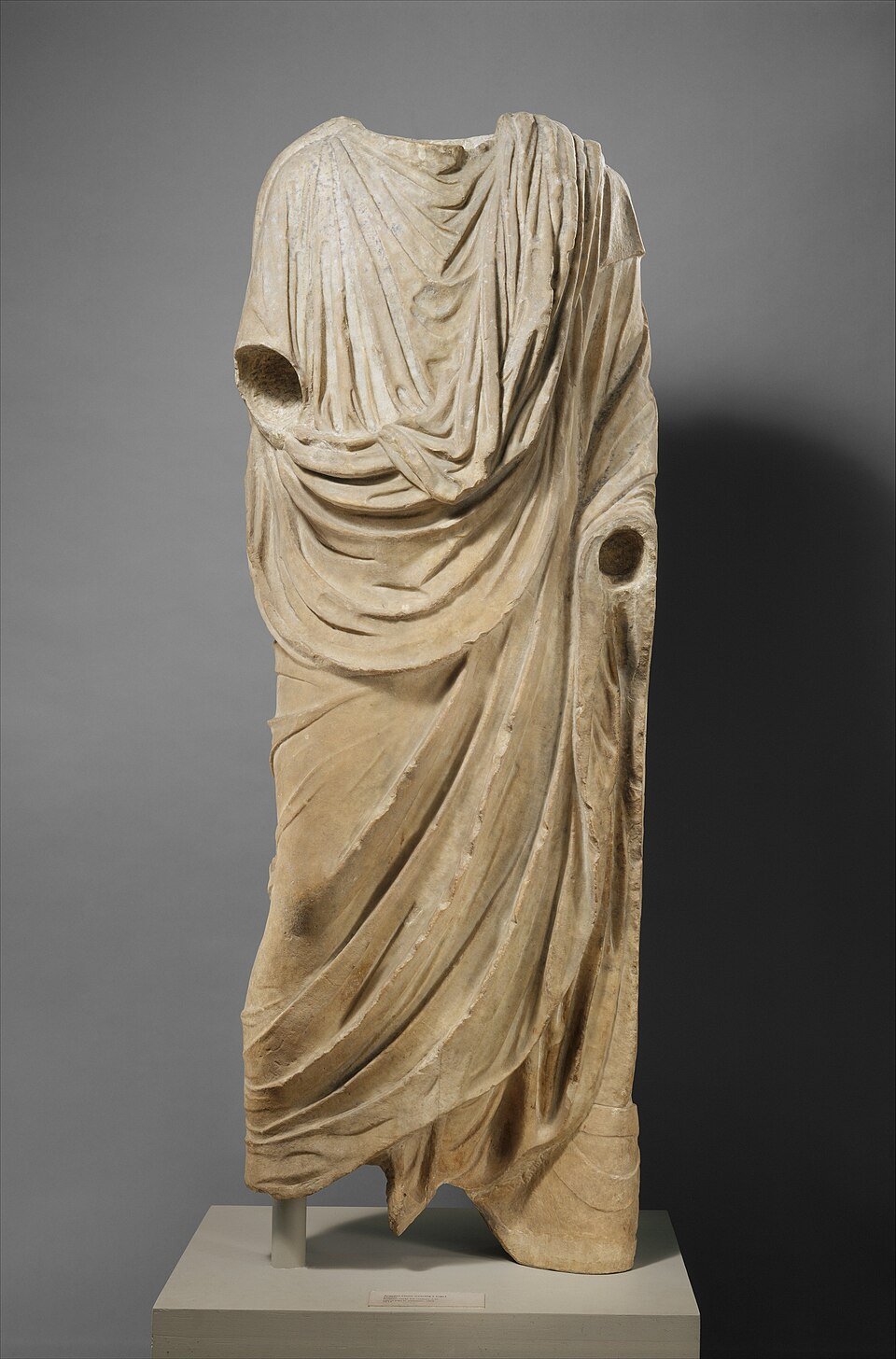
A toga is a single large piece of undyed wool, roughly a semicircle, arranged in careful folds over a tunic. Cumbersome and impossible to work in, it was worn for public and ceremonial occasions as the mark of the free Roman citizen, forbidden to foreigners and the enslaved.
How it is worn
It is draped rather than sewn: one end falls down the front, the bulk passes over the left shoulder, under the right arm, and back over the left, leaving the right arm free, with a pouch of folds (the sinus) at the front. Keeping it in place demanded a slow, dignified bearing.
History
Bordered forms carried meaning — the purple-edged toga praetexta for magistrates and freeborn boys, the plain toga virilis assumed at manhood, the artificially whitened toga candida of election candidates. Cumbrous even to Romans, it faded from daily use under the Empire but survived as ceremonial dress.