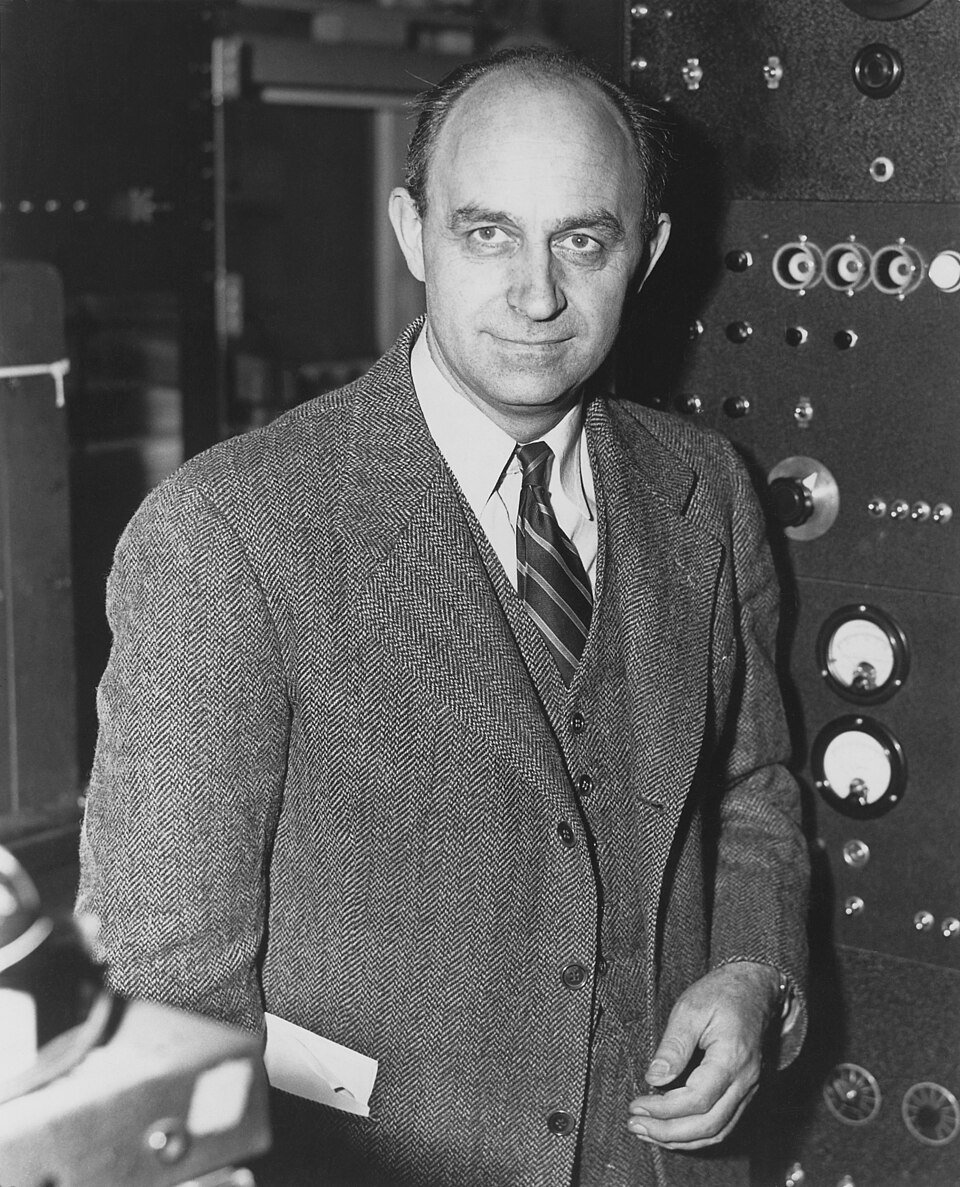
Who they were
Enrico Fermi was born in Rome and became a professor of physics there in his mid-twenties. He is often described as the last physicist who stood in the first rank in both theory and experiment.
What they did
In Rome he worked out the statistics obeyed by the particles now called fermions and a theory of beta decay that introduced the weak interaction. With his team, known as the Via Panisperna boys, he bombarded elements with neutrons and discovered that slowed neutrons trigger far more reactions — work that won the 1938 Nobel Prize in Physics. Italy’s racial laws of that year threatened his Jewish wife, Laura, and the family sailed for America straight from the Nobel ceremony in Stockholm. At the University of Chicago on 2 December 1942 his team started Chicago Pile-1, the first self-sustaining nuclear chain reaction, and he went on to become a central figure of the Manhattan Project at Los Alamos.
Legacy
After the war he taught at the University of Chicago, where his students included several future Nobel laureates. He died of cancer in 1954, aged 53. Element 100, fermium, and Fermilab near Chicago carry his name, and terms like fermion and the Fermi paradox stitch it through physics.