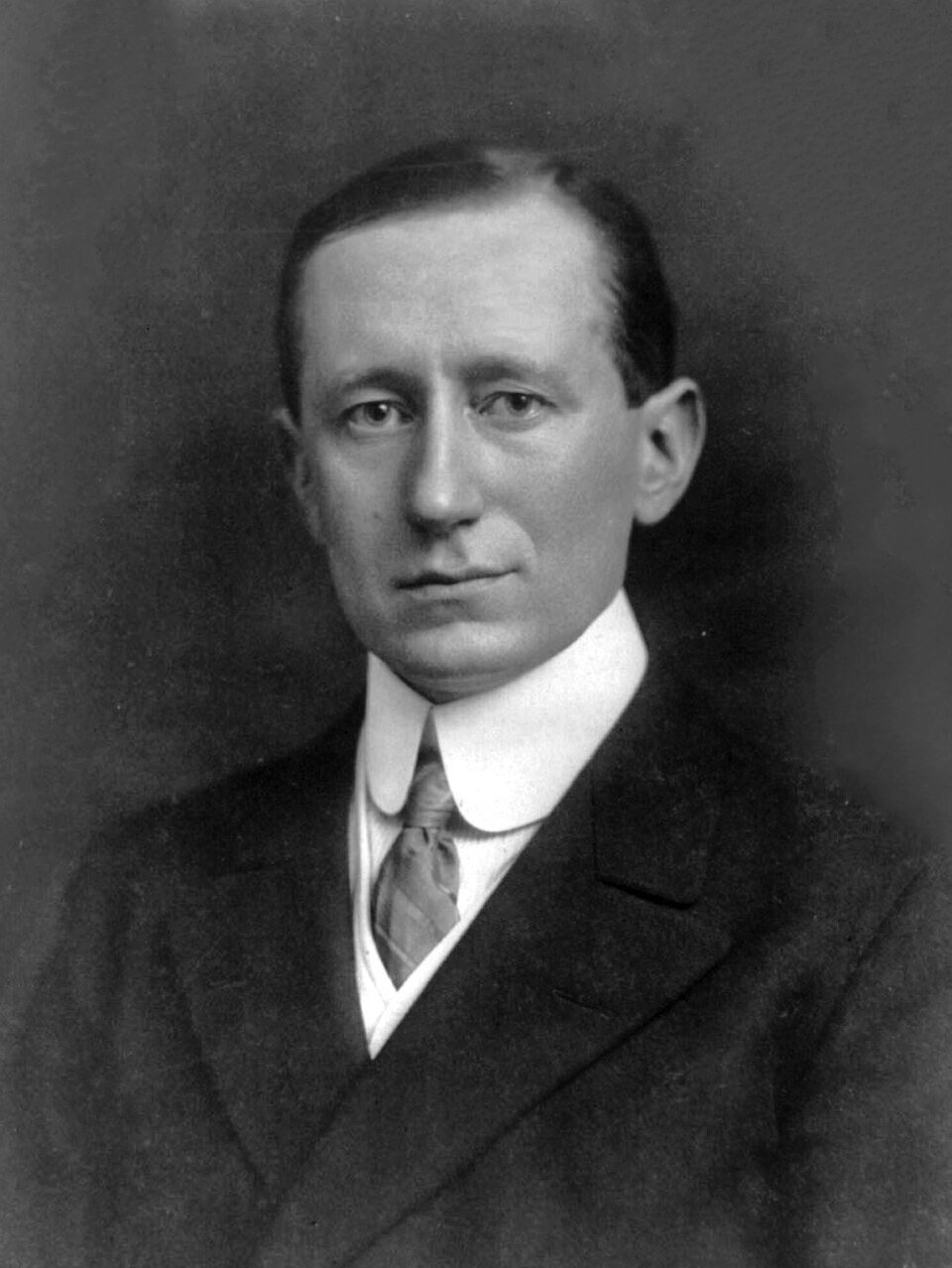
Who they were
Guglielmo Marconi was born in Bologna to an Italian landowner and an Irish mother. Largely self-taught in physics, he began experimenting with Hertz’s radio waves as a teenager at the family villa, and by 1895 he could send signals beyond the line of sight, over a hill.
What they did
Finding little interest in Italy, he moved to Britain in 1896, filed the first patent for wireless telegraphy, and built a company that put radio on ships and across the sea. On 12 December 1901 he reported receiving the Morse letter S, sent from Poldhu in Cornwall, at St John’s in Newfoundland — the first transatlantic wireless signal. He shared the 1909 Nobel Prize in Physics with Karl Ferdinand Braun, and when the Titanic sank in 1912 its survivors were rescued because Marconi operators had radioed for help. In later life he developed shortwave long-distance links; he joined the Fascist Party in 1923 and served the regime as president of Italy’s Royal Academy.
Legacy
Marconi did not discover radio waves, but more than anyone he made them a global technology. When he died in Rome in 1937, radio stations around the world went silent for two minutes; broadcasting, ship-to-shore radio, and everything wireless descends from the industry he founded.