Overview
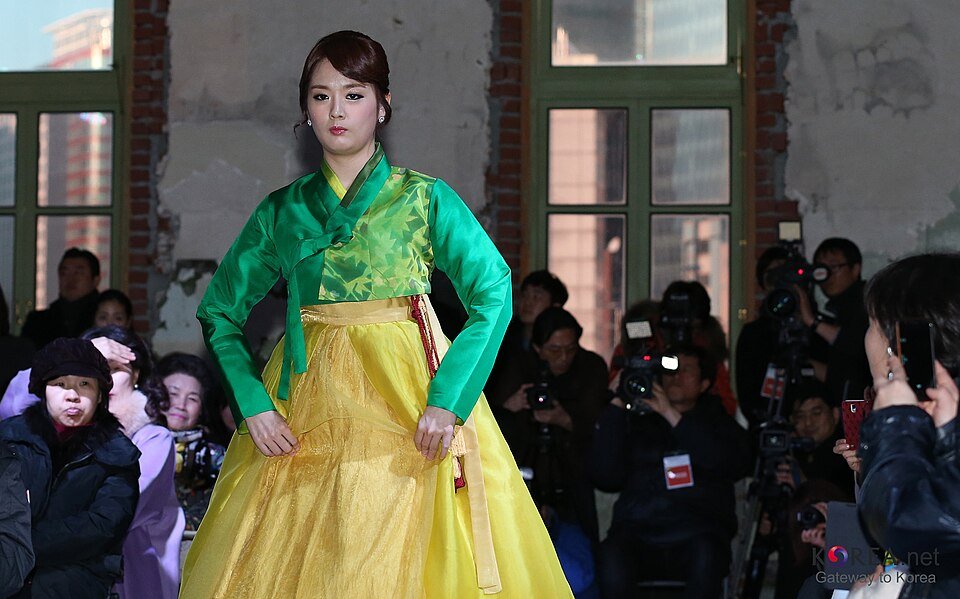
The garment did not change; its job did. Western clothing became ordinary dress through the 1950s and 60s, and by the 1970s a hanbok in a household was ceremonial property rather than a wardrobe. The cut it settled into is the late Joseon one: a very short jeogori jacket tied with a single long bow, and a chima skirt gathered from a high band under the arms, worn full over an underskirt. What did change was the making. Synthetic fabrics took over from ramie and silk, chemical dyes widened the palette far past anything the nineteenth century could reach, and the skirt grew fuller than it had ever been.
How it is worn
The jeogori goes on like a short jacket and is closed by the goreum, a pair of ribbons of unequal length tied into one large loop that hangs down the front; getting that knot right is the part people are taught and the part they forget. The chima is wrapped around the body above the bust and tied there, over an underskirt that gives it its bell, so the whole weight of the skirt hangs from the chest rather than the waist. With it go beoseon, stiff white split-toe socks, and for ceremony shoes with an upturned toe. Men wear loose baji trousers tied at the ankle under a jacket of the same cut, with a durumagi coat over both to go outdoors. Modern versions cut corners the old one could not: a zip at the skirt band, a ready-tied bow, velcro, and a petticoat that holds the shape without the layers underneath.
History
Two lines run alongside the ceremonial version. Reform hanbok, from the late 1970s and 1980s onward, cuts the same shapes for daily use — a longer jacket, ties that stay tied, a skirt that will survive a bus — and is worn by people who want the garment without the occasion. Rental hanbok is the other: since 2013 visitors wearing hanbok have entered Seoul’s royal palaces free, and shops opened around the gates to dress them for the day, which is why most of the hanbok visible in Seoul now belongs to nobody who is wearing it. The division also put two names on one garment — hanbok in the South, joseonot in the North — and the two have drifted apart in silhouette and in the occasions that call for them. Since the 2010s the southern version has moved again, pulled by designers who use its lines in ordinary clothing and by performers who wear it abroad.