Overview
The áo dài that is now the Vietnamese national dress is largely a product of this period, and can be dated with unusual precision. Colonial cities brought European tailoring, magazines and a fashion press, and in that setting a specific designer reworked an older court garment into something new — modernisation carried out by Vietnamese, in Vietnamese terms, inside a colonial situation.
Key garments and style
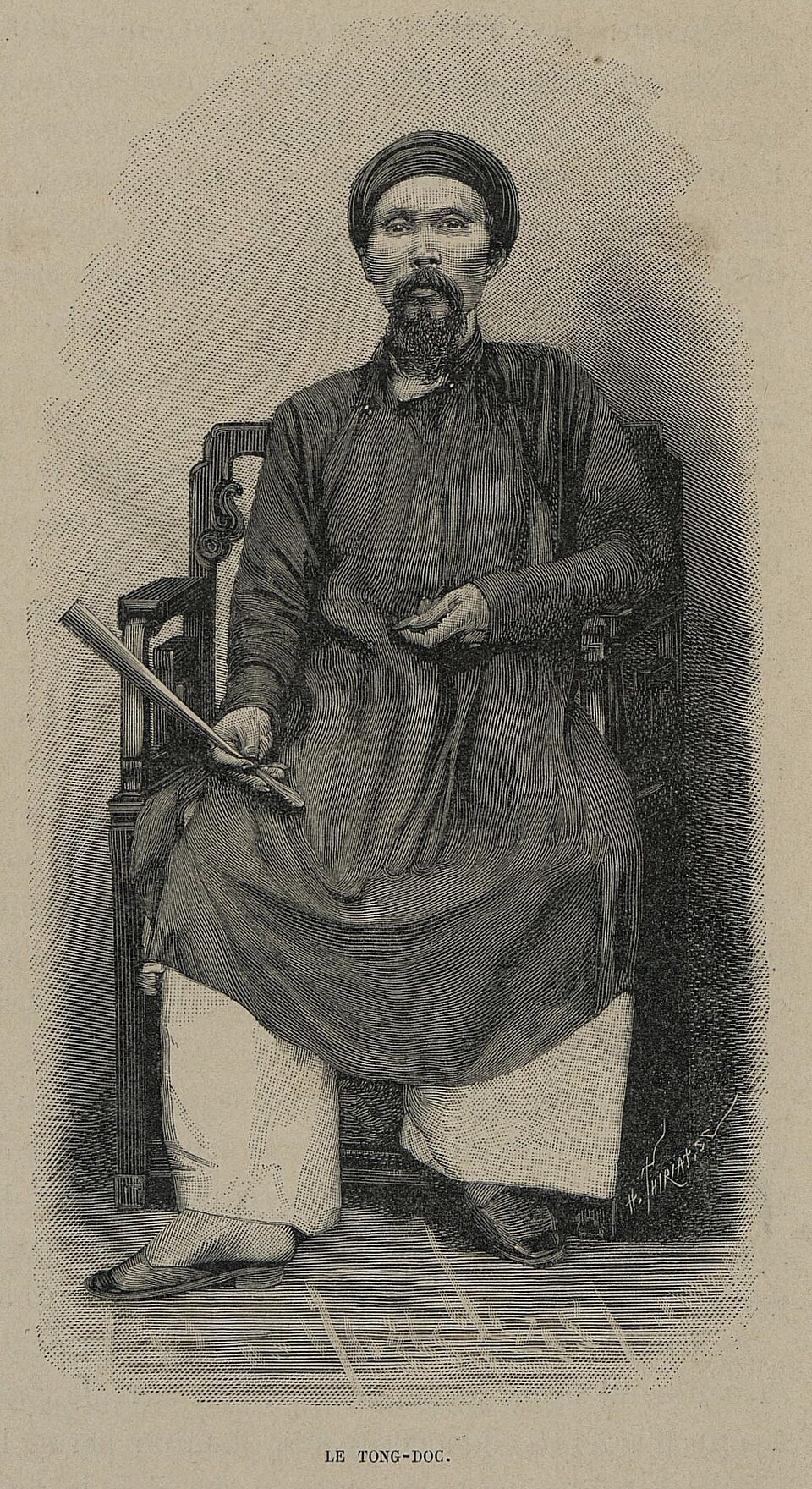
The starting point is the áo ngũ thân, the five-panel tunic worn loose over trousers. In the mid-1930s the Hanoi painter Nguyễn Cát Tường, who signed himself Le Mur, redrew it for the magazine Phong Hóa: fewer panels, seams shaped to follow the body, the fastenings moved, the skirt lengthened, and European details at the sleeve and neckline, worn over white trousers. It was argued over as immodest and as a foreign import, and it was adopted anyway. The garment recognised today is later still: the diagonal raglan seam running from collar to underarm, which removed the wrinkling at the armpit, is a Saigon innovation of the late 1950s, a quarter century after Le Mur.
Men in the cities moved to European suits, and the pith helmet and the beret became ordinary urban wear. In the countryside neither change reached far: the áo bà ba, the wrapped lower garment and the conical nón lá continued.
Colonial dress was also legible as rank — the graded uniforms of the administration marked exactly where a Vietnamese official stood in a French hierarchy.
Transition
After 1945, through independence and partition, the áo dài became a national symbol carried by both Vietnamese states and by the diaspora, its colonial-era origin largely forgotten.