Overview
The Nguyễn are the dynasty that legislated Vietnamese dress into its modern form. Two decrees did most of the work — one in the eighteenth century in the southern domain, one in the nineteenth over the whole country — and between them they replaced the wrapped skirt with trousers and the open robe with a front-fastening tunic, which is the direct line to the áo dài.
Key garments and style
The garment those decrees produced is the áo ngũ thân, the five-panel tunic: a long gown of joined panels fastening along the right side, worn over trousers, with a breast cloth beneath for women. Worn with the conical nón lá it is the silhouette that reads as Vietnamese in nineteenth-century photographs.
Its spread was not organic. Nguyễn Phúc Khoát required trousers and a front-closing gown in the southern territories in the 1740s, distinguishing his court from the Trịnh in the north; Minh Mạng then extended the requirement nationally in the 1820s and 1830s and moved against the northern women’s váy skirt directly. Compliance was uneven and resented, and the four-panel áo tứ thân continued in the north for generations.
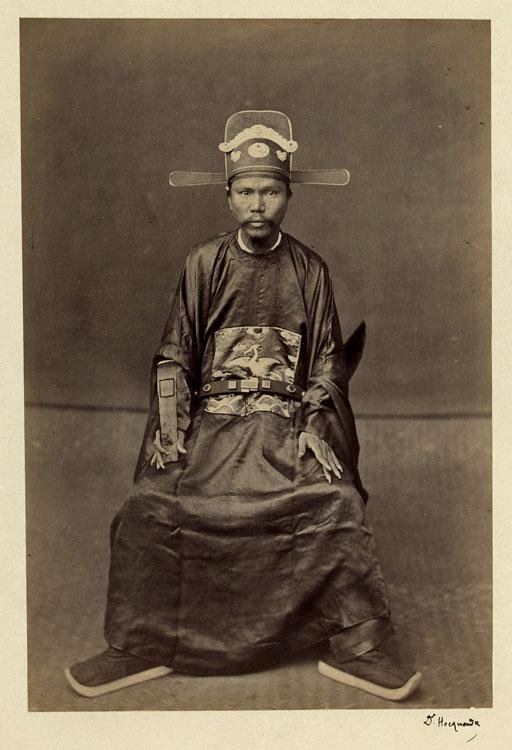
At court, ceremonial robes in graded colours and patterns followed a Sinitic system, with yellow reserved to the emperor.
Transition
Under French rule this five-panel tunic was recut into the fitted modern áo dài, so the national dress descends from a garment originally imposed by decree.