Overview
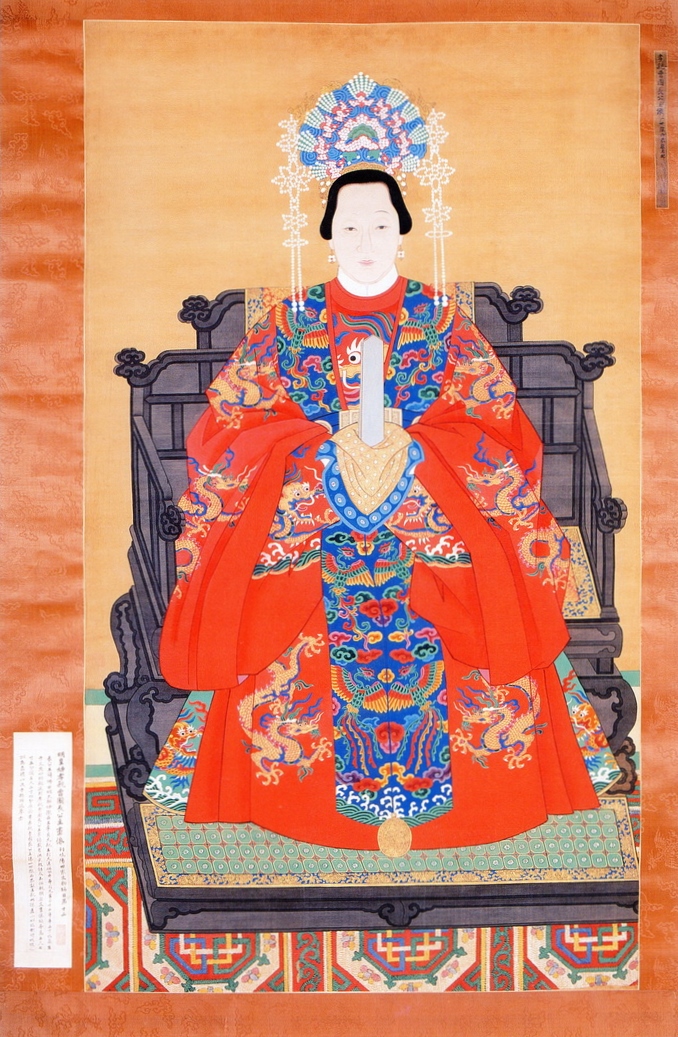
It is not a scarf but a rank insignia in cloth: two strips joined at the neck, falling to below the knee, embroidered along their length and finished with a pendant plaque, the zhuizi. Ming regulations set the design by rank — phoenixes and cloud motifs for the highest, pheasants and flowers below, with gold for the top ranks and gilt or silver beneath — so a woman’s xiapei read as precisely as a man’s badge of office. It is worn with the dayishan robe and, at the top of the scale, with a phoenix crown.
How it is worn
The bands go over both shoulders with the joined end at the neck, cross nothing, and hang straight down the front, held in place by the weight of the pendant rather than by fastening. Worn over the formal robe, they narrow the silhouette and mark the centre line. Because they are rank rather than dress, they go on last, and a portrait shows them arranged flat and symmetrical — any disorder would be a mistake in the sitting rather than a style.
History
The form descends from Song court dress and the Ming made it a graded system; the Qing kept the name and the shape but changed the rules, and by the late imperial period the xiapei had also become the standard bridal wear of ordinary women — the phrase fengguan xiapei, phoenix crown and xiapei, means a proper wedding to this day. That is how a rank insignia ended as a wedding costume, and why the two words still travel together.