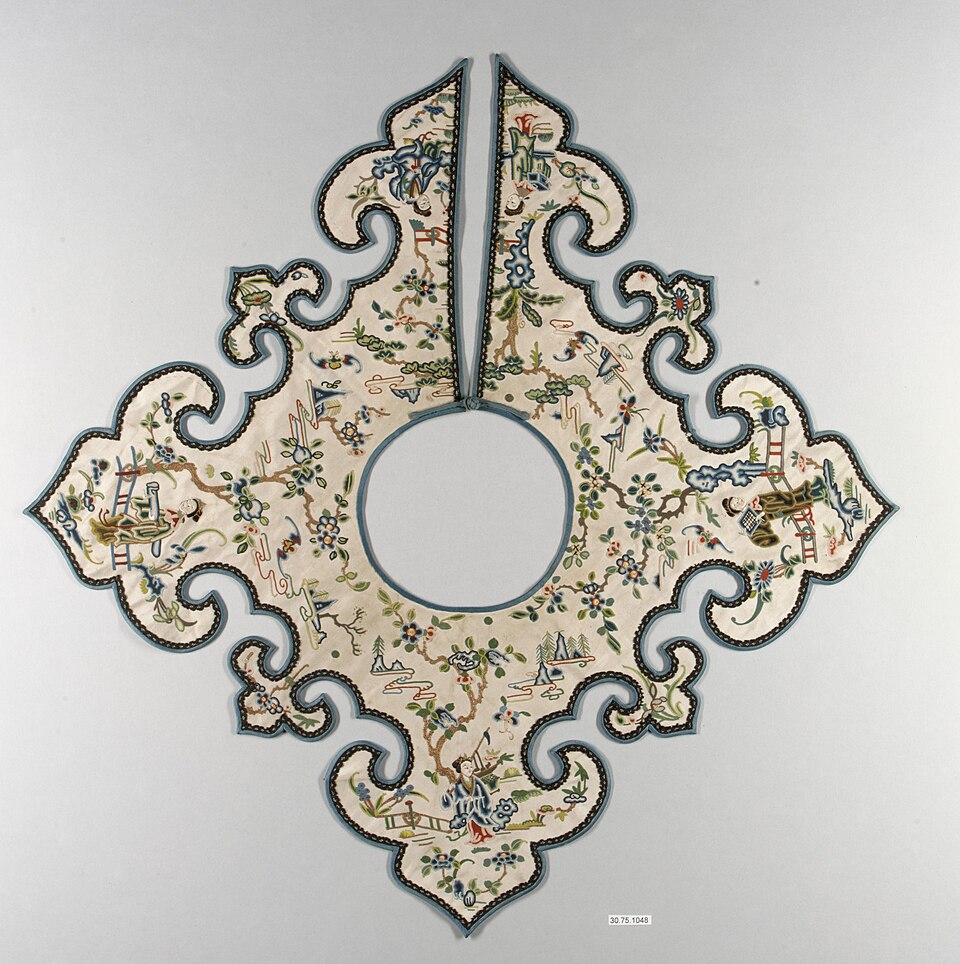
Overview
It is a flat ring of cloth with a hole for the head, cut into lobes that fall over the shoulders and chest — four in the classic form, sometimes many more in later and folk versions. Each lobe is embroidered separately and edged, often with tassels or beads at the tips, and the whole is put on and taken off as one object. Because it sits on top of everything, it can be as rich as the household can afford without altering the robe underneath.
How it is worn
It drops over the head and settles by its own weight, with one lobe centred at the front, one at the back and one on each shoulder; nothing fastens. That is what makes it useful on a wedding day — the collar can be lifted off a borrowed or inherited robe and worn by the next bride. In folk use it also protects the shoulders of a good robe from hair oil, which is the practical reason a decorative piece survives on working dress.
History
The four-lobed collar appears in Chinese art well before the Qing — it is on Yuan and Ming figures, and its ancestry is often traced to Central Asian dress — but it is in the Qing and the Republican decades that it becomes the standard bridal accessory and a staple of folk embroidery across many regions and minorities. Museum collections are dominated by Qing examples for that reason, and the piece is now a recognisable element of hanfu revival dress.