Overview
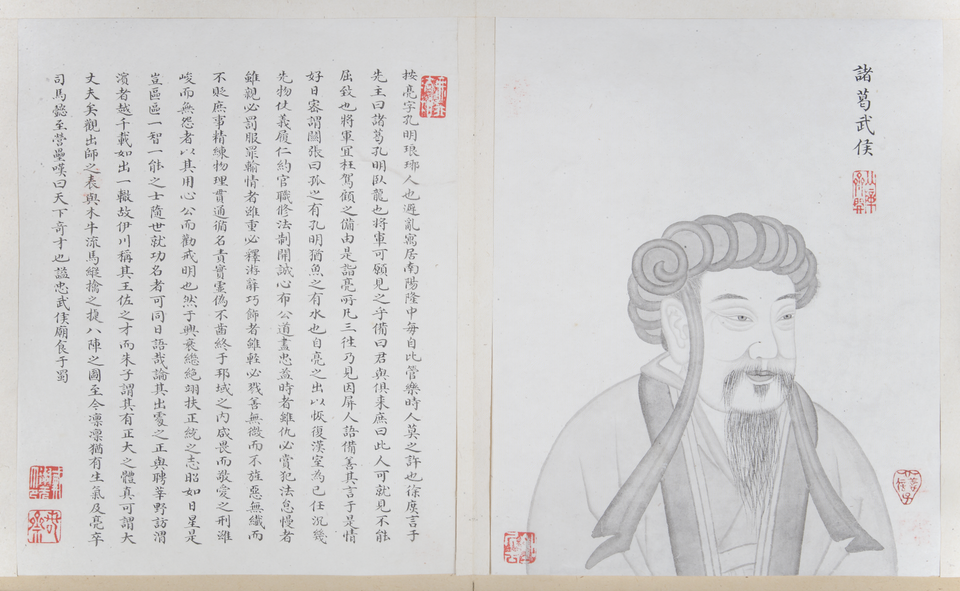
Han officials wore a lacquered gauze cap, the guan, over a cloth underwrap. The lunjin is the underwrap promoted to the whole of the headdress: a length of dark silk, wound and knotted over the hair, with no frame and no rank. That is its meaning. To appear in it at court business was to appear as a man of learning rather than of office, and in a century when office was worth little and armies decided everything, that pose had a particular value. It belongs to the same wardrobe as the wide-sleeved robe and the feather fan.
How it is worn
The cloth is folded to a band, laid across the forehead, taken back over the topknot and tied, with the ends left to hang or tucked away. Because there is no stiffening, the shape follows the knot of hair beneath it, and the wearer’s own topknot does the work a cap frame would otherwise do. It is put on in a moment and it stays on a horse; both of those are part of why it suited a man who wanted to look like a civilian in a war.
History
The garment is inseparable from one story. In the Records of the Three Kingdoms and in the novel that grew from them, Zhuge Liang directs a battle in a plain headscarf and a feather fan, and the image fixed itself so firmly that later Chinese usage calls the scarf the Zhugejin outright. Song and Ming scholars wore versions of it as a deliberate quotation. What began as an undergarment for a cap ended as a costume for a role.