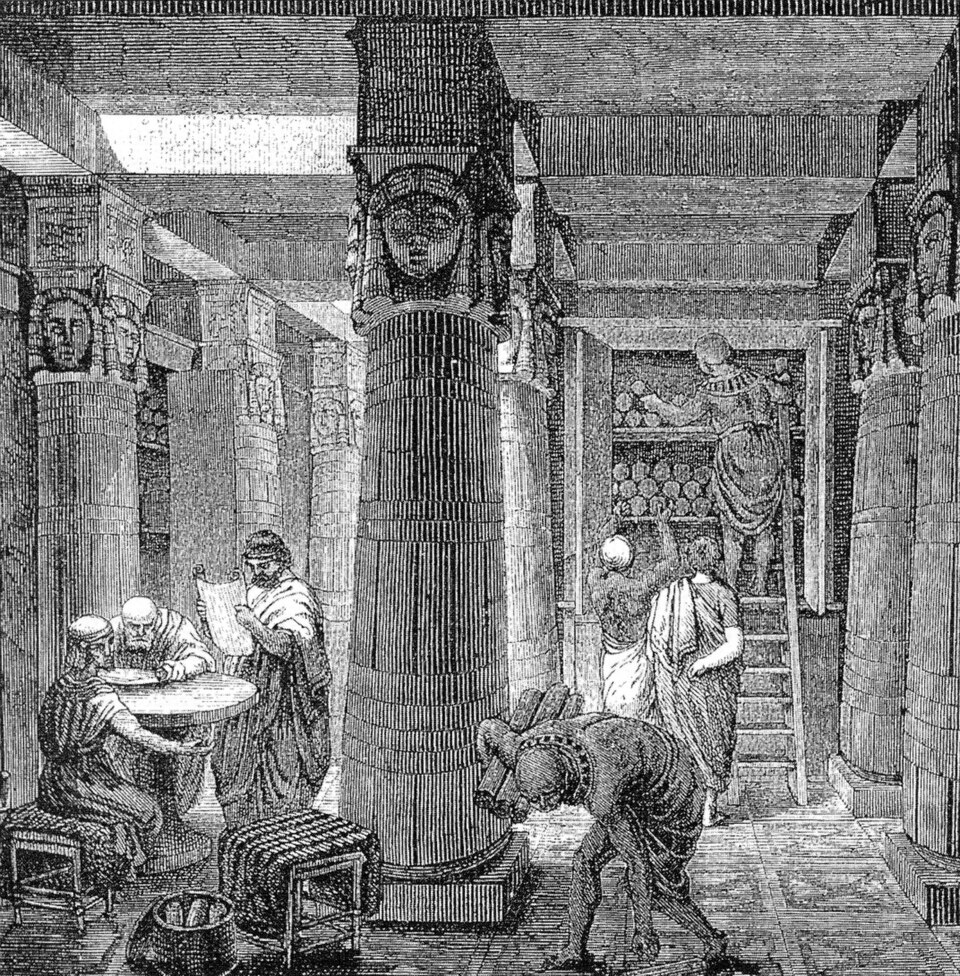
What it was
The Library was founded in the early 3rd century BC under Ptolemy I, Ptolemy II, or both, as part of the Mouseion — a shrine of the Muses that served as a royal research institution in Alexandria. Its ambition was to collect all the world’s writings. Ancient claims about its size range from tens of thousands to hundreds of thousands of scrolls, and these figures are unreliable.
Role
The Library made Alexandria the center of Hellenistic scholarship, spanning the editing of Homer, mathematics, astronomy, geography, and medicine. Scholars associated with it or with the city include Eratosthenes, who calculated the circumference of the Earth; Callimachus, whose Pinakes was a pioneering library catalog; and Aristarchus of Samothrace, known for his textual criticism of Homer. Euclid, too, worked in Ptolemaic Alexandria.
Fate
Its end was gradual, not a single fire. Per ancient accounts, Caesar’s war fire of 48 BC damaged book stores; the Brucheion palace quarter was devastated in Aurelian’s reconquest in the 270s; and the daughter library in the Serapeum was destroyed in 391. The popular tale of one catastrophic burning is a myth. In 2002 the Bibliotheca Alexandrina, a modern library commemorating it, opened in Alexandria.