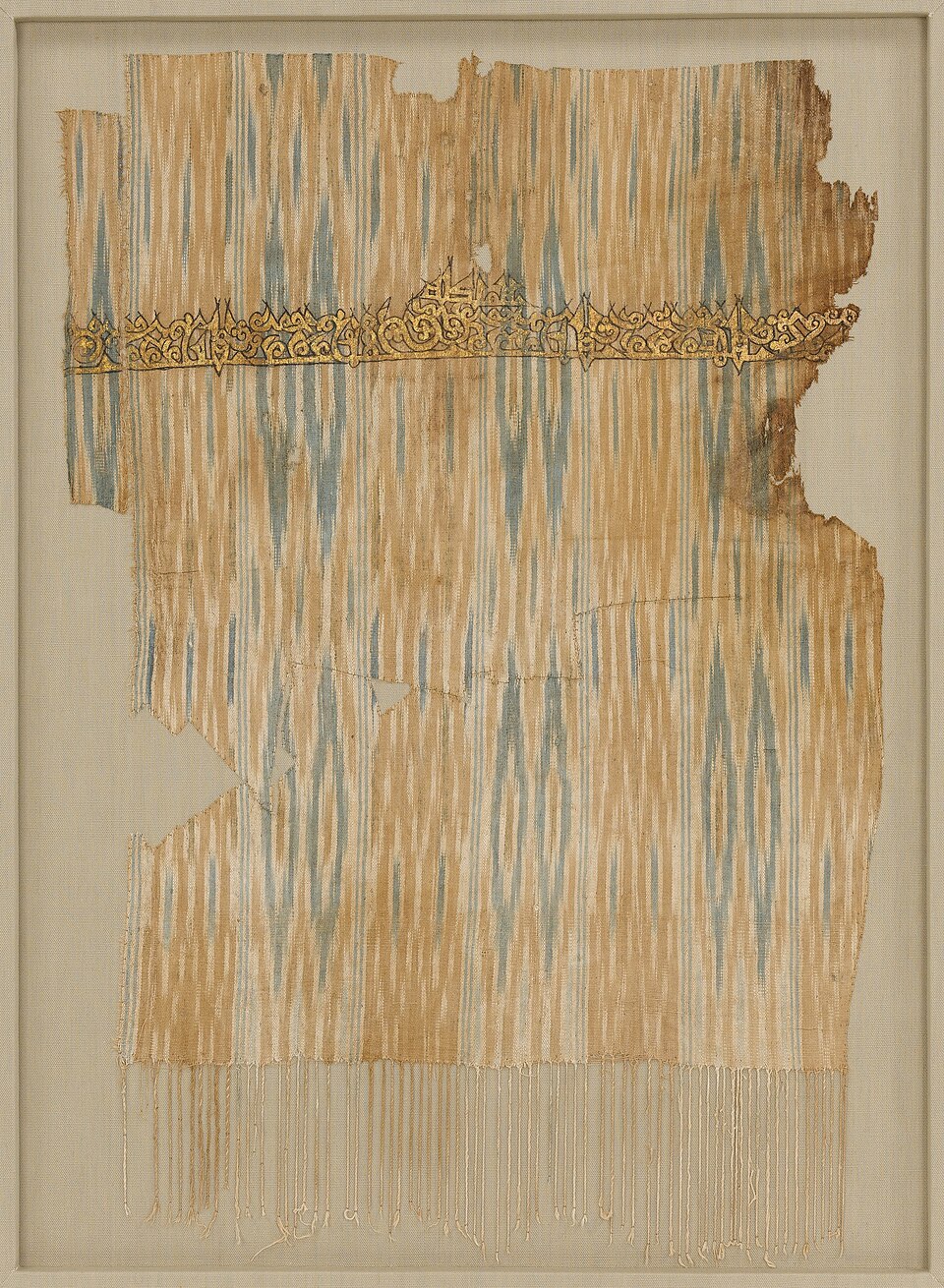
Overview
The word covers both the band and the state workshop that made it. Under the Fatimids, Egypt’s tiraz factories at Tinnis, Damietta and elsewhere produced inscribed linens for the court, and the surviving pieces are dated, named and located by their own text: the ruler, sometimes the official who ordered the cloth, sometimes the year. That makes tiraz fragments unusually precise historical documents, and they are cited for chronology far outside textile history.
How it is worn
The band sits on the sleeve of a robe at the upper arm, where it is visible from the front and from the side, and where a raised arm displays it. It is woven into the cloth in tapestry technique or embroidered on afterwards; the script is Kufic in the earlier pieces and cursive in the later. Since the honour is in the text rather than in the garment, the same inscribed band could be transferred, and worn robes were re-cut with the band preserved.
History
The practice runs from the Umayyads through the Fatimids and Ayyubids into the Mamluk period, and it spread wherever the caliphal ceremony of the robe of honour went — to Islamic Spain, to Persia, to the Seljuk courts, where the arm-band appears on figures who never saw Cairo. When state workshops declined, the band survived as ornament, and inscribed-looking bands with no readable text are common on later cloth.