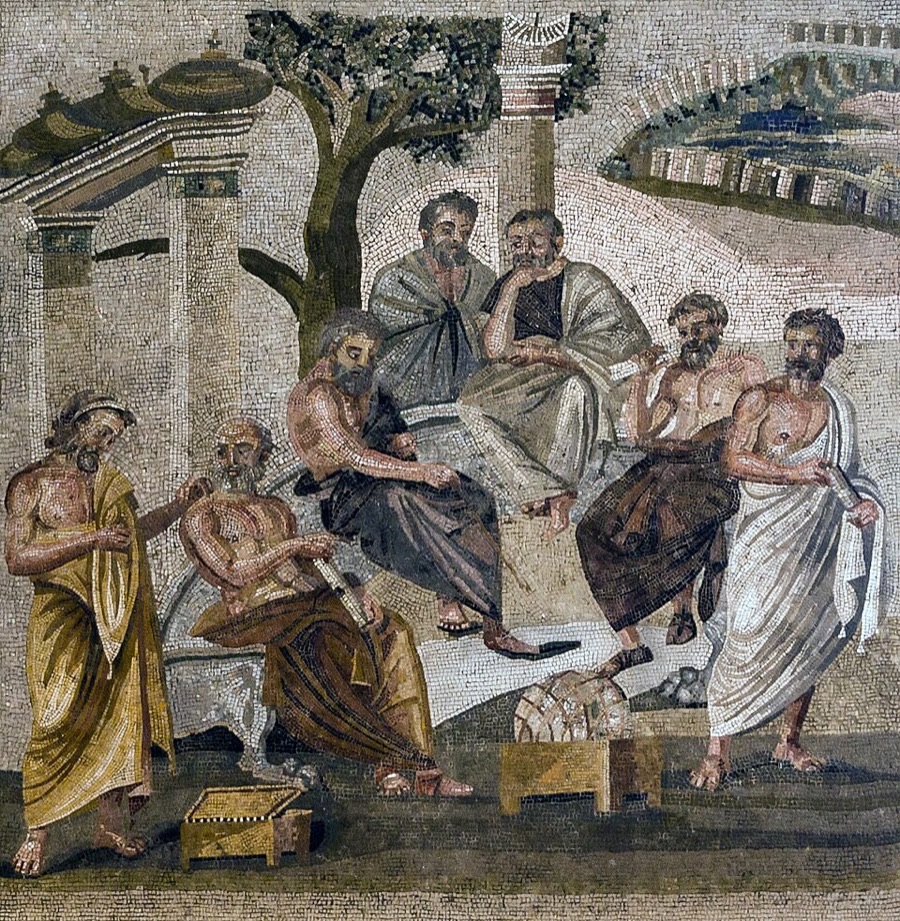
What it was
Plato founded the Academy c. 387 BC in a grove sacred to the hero Akademos outside the walls of Athens; the name Academy descends from the place. It is often called the first institution of higher learning in the Western world.
Role
Its studies centered on mathematics and geometry — legend has it that an inscription over the door barred entry to anyone ignorant of geometry — along with dialectic and astronomy. Aristotle, who spent twenty years there, was its most famous student, and Eudoxus was among its mathematicians. The school’s history falls into phases: the Old Academy of Plato’s successors, the skeptical turn of the Middle and New Academy under Arcesilaus and Carneades, and refoundations under later Platonists.
Fate
The original grove and buildings were destroyed in Sulla’s siege of Athens in 86 BC, though teaching traditions continued in the city. The Neoplatonic school of Athens — heir to the name — was closed by the emperor Justinian in AD 529; its last head, Damascius, and his colleagues briefly sought refuge in Sasanian Persia, and 529 is the conventional end-date of ancient philosophy. The word academy, used for institutions of learning everywhere, descends from the school, and the site in Athens is today an archaeological park.