Overview
Golestan Palace, the Palace of Flowers, is the oldest royal complex of Tehran. Its beginnings go back to the citadel walls raised under the Safavid shah Tahmasp I in the 16th century; Karim Khan Zand added buildings in the 18th century, and after Agha Mohammad Khan made Tehran his capital in 1786 it became the seat of the Qajar court.
Description
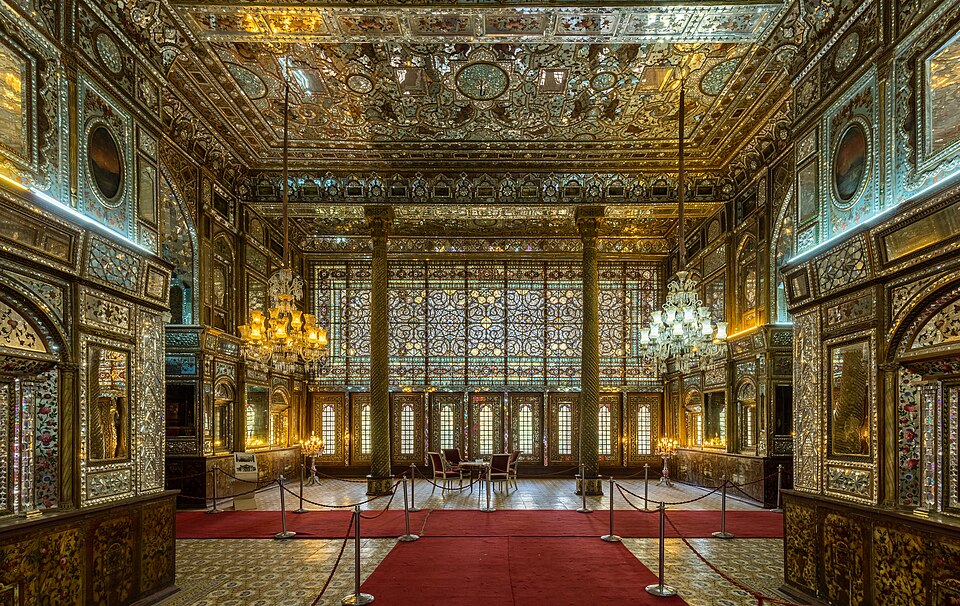
The complex gathers halls and pavilions around a garden courtyard. The Marble Throne, an alabaster platform of 1806 set in an open veranda, was the stage for coronations; the Shams-ol-Emareh, completed in 1867, was among the tallest structures of Qajar Tehran and shows the era’s taste for joining Persian tilework with European clocks and windows. Mirror-mosaic halls such as the Talar-e Ayeneh display the court’s most celebrated craft.
History and legacy
Naser al-Din Shah, impressed by his travels to Europe, rebuilt much of the complex in the later 19th century. Under Reza Shah parts of the surrounding buildings were demolished in the 1920s and 1930s to make way for a modern administrative quarter, yet both Pahlavi rulers still held their coronations here, in 1926 and 1967. The palace became a museum complex and was inscribed on the UNESCO World Heritage list in 2013 as a masterpiece of the Qajar era.