Overview
Seljuk dress is where the Turkish steppe wardrobe and the Persian court tradition were fused into something that outlasted both. Turkic rulers arriving as horsemen took over a Persian administrative culture and an Islamic ceremonial one, and the resulting style — the fitted coat over trousers and boots, worn with the turban of the Muslim city — became the basic vocabulary of court dress from Anatolia to India for centuries afterwards.
Key garments and style
The characteristic garment is the qaba, plural aqbiya: a coat cut close through the body, opening down the front, often with one lapel folded back across the chest and worn with a belt over trousers and soft boots. Over or under it went silk robes, and on the head the wound turban, or for Turkish military men a fur-trimmed cap. Men are frequently shown with long braided hair, a steppe habit that Persian court painting kept for generations.
Cloth here was also currency and politics. The khil’a, the robe of honour, was a formal instrument of rule: a ruler invested an official, an ally or a vassal by clothing him, and to accept the robe was to accept the relationship. Many robes carried tiraz, bands of woven or embroidered inscription naming the sovereign, so the wearer’s allegiance was legible on the garment itself. The silks retained a strong inheritance from Sasanian weaving, roundels and confronted animals included.
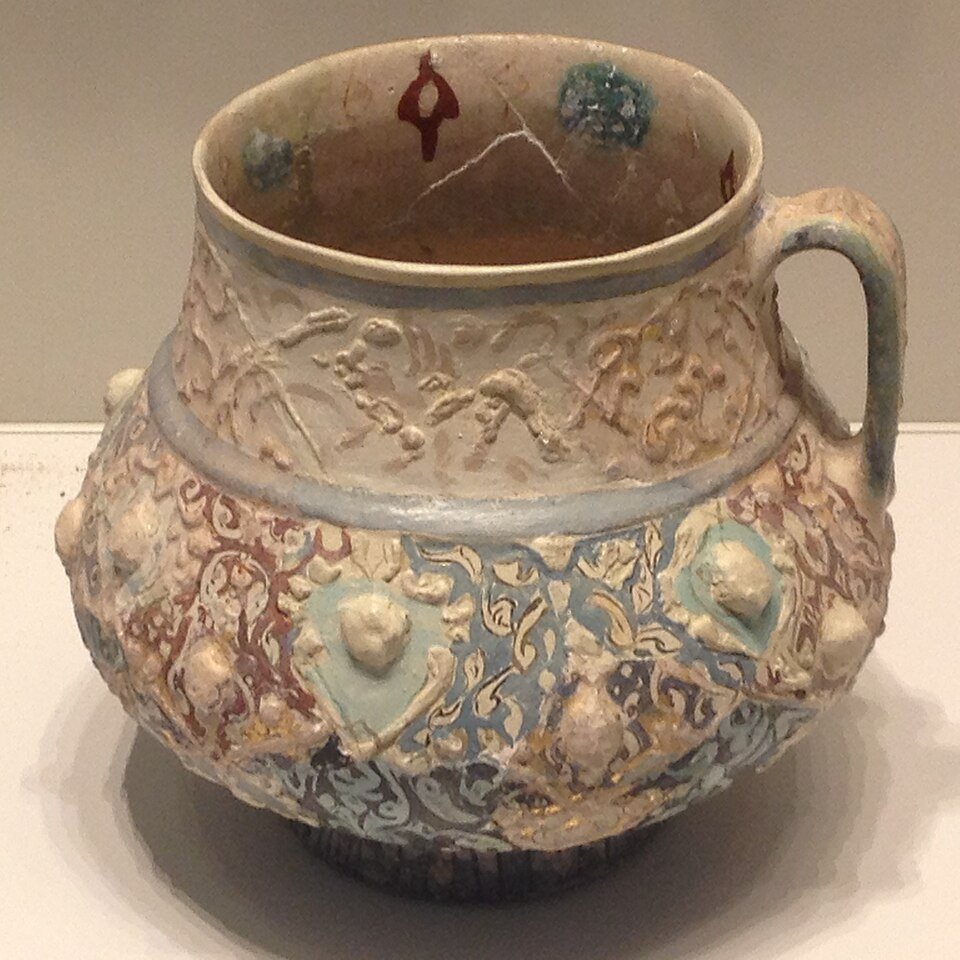
The visual record is unusually good for the period. Polychrome mina’i ware from Kashan, painted in enamels over the glaze, shows princes, riders and seated courtiers in patterned coats, and moulded stucco figures of guards and attendants survive from Iranian palace halls.
Transition
The Mongol conquest and the Ilkhanate that followed added an East Asian layer — new cuts, new hat forms and Chinese-derived silk patterning — onto this Turco-Persian base rather than replacing it, and the mixture carried forward into Timurid and Safavid dress.