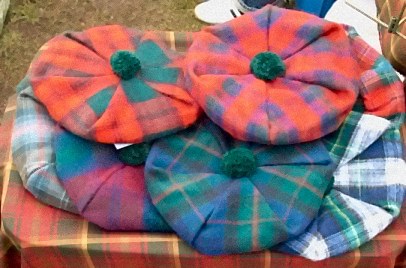
Overview
It is knitted or milled from wool in one piece, felted so the edge does not fray, and gathered onto a close band that grips the head; the crown is left wide and flat so it can be pulled to one side. A toorie — the pompom — sits at the centre. The plain blue bonnet worn across Scotland for centuries is the same object, and the tam is what that bonnet became once it was named, patterned in dicing or tartan, and worn deliberately.
How it is worn
It is put on level and then pulled down over one ear so the crown sits at an angle, which is the wearing that distinguishes it from a flat beret; the band should grip without a fastening. In military use the angle, the badge and the toorie’s colour are regulated, and a regiment’s tam is a uniform item rather than a style — the balmoral is its stiffer, more formal cousin.
History
Robert Burns published Tam o’ Shanter in 1790, and the bonnet took the name of its hero over the following decades. The Scottish regiments adopted it in the First World War as a practical alternative to the glengarry, which put it on soldiers of many nations, and the fashion trade did the rest: a tam has been in and out of women’s fashion since the 1920s, usually in wool, usually with the toorie kept. It is now worn as Scottish dress, as uniform, and as an ordinary hat, and the three are cut the same.