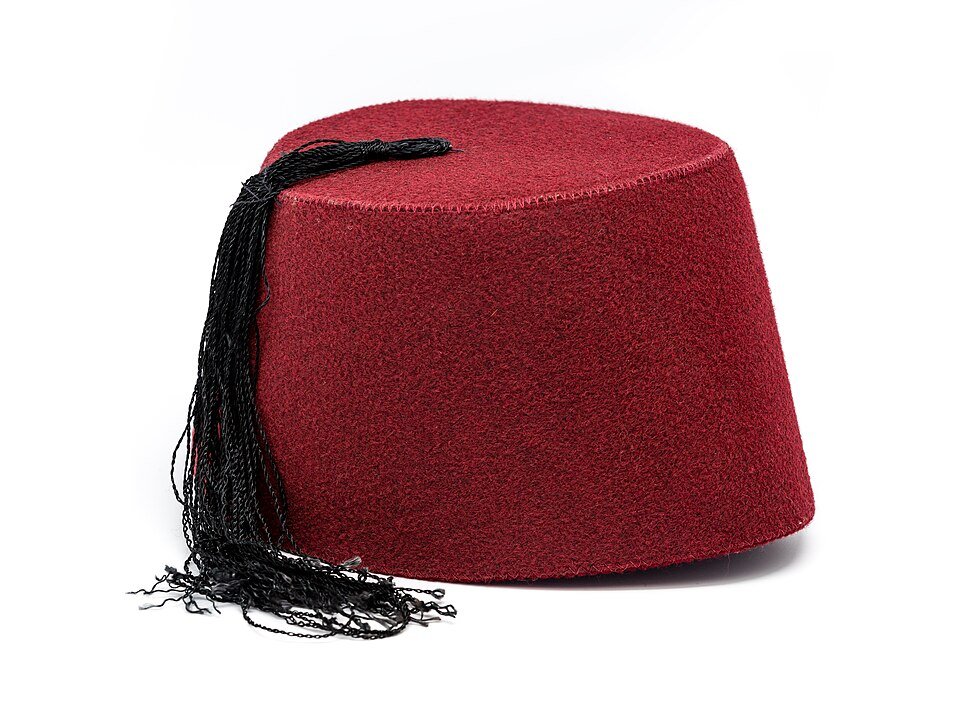
Overview
It arrived as a reform rather than a fashion. In 1826 Mahmud II abolished the janissaries, and with them the turban; the clothing regulation of 1829 then put the fez on the Ottoman army and civil service as a deliberately modern, deliberately uniform substitute — a hat that made no statement about a man’s religious school, his region or his rank. Egypt under Muhammad Ali and his successors, modernising along the same lines and with the same models, followed. Within a generation the tarboosh had become the mark of the effendi: the salaried, schooled, city man, as against the turbaned religious scholar on one side and the bare-headed or skull-capped peasant on the other.
How it is worn
It is worn straight, sitting on the crown, usually over a thin skullcap that keeps the felt off a shaved head; the tassel falls behind or to the side. Felt has no give and holds no shape by itself, so the tarboosh is blocked — pressed onto a heated brass form — and every town had a shop with the machine that did it. A crushed tarboosh could be sent back to be re-blocked, which is why they last, and why a well-kept one holds the edge shown here. The colour is fixed and the black tassel with it; nothing about the object is adjustable, which is exactly what made it a uniform.
History
The same quality made it a target. Turkey banned it outright in 1925, when the republic legislated the brimmed hat. In Egypt it lasted longer, because it had become genuinely national rather than merely Ottoman, but it fell with the order that wore it: after the revolution of 1952 the tarboosh drops out of official and then ordinary use within a few years, and the bare head that replaced it was itself a political statement. It survives now in ceremonial dress and as a shorthand, in Egyptian film and cartoons, for the era before.