Overview
Italian dress in these decades followed Paris like everyone else’s, so the interesting thing about the Risorgimento is not fashion but uniform: a plain red shirt became the most legible political garment in nineteenth-century Europe, and then, remarkably, became a fashion in the countries that had nothing to do with the cause.
Key garments and style
Elite women wore what Paris dictated — the crinoline expanding through the 1850s and 1860s, then collapsing into the bustle silhouette — and men the frock coat and increasingly the sober suit.
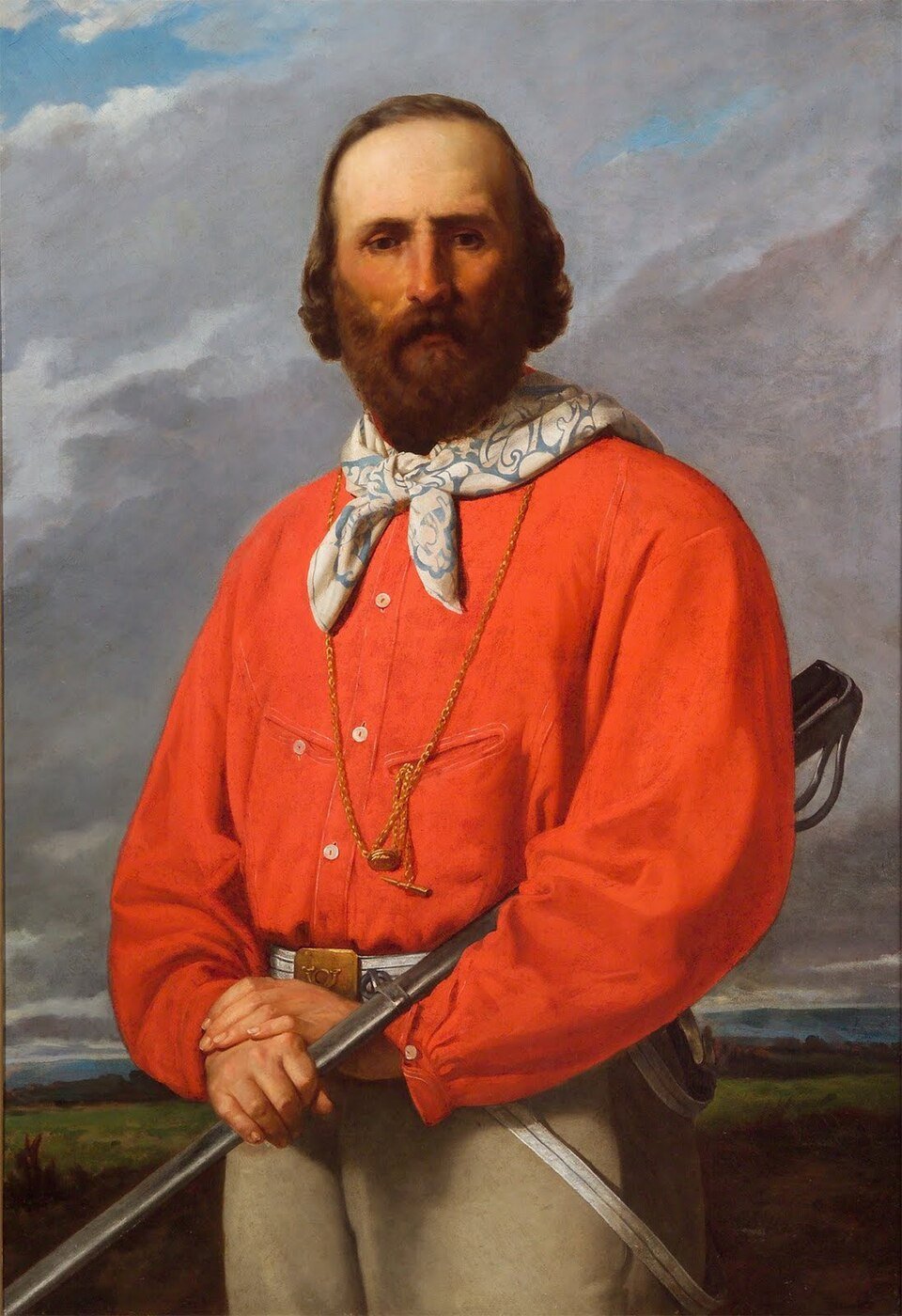
Against that, the camicia rossa. Garibaldi’s volunteers wore red shirts, and the garment worked precisely because it was not a uniform: cheap, uniform in colour rather than cut, wearable by men who had no army to equip them. The usual account traces the first shirts to a supply obtained in Montevideo during his South American years, and the detail is repeated everywhere but is hard to pin down, so it is better treated as tradition than as established fact.
What is documented is the afterlife. Following the Thousand’s landing in Sicily in 1860, Garibaldi became a celebrity in Britain and France, and a loose red wool blouse sold as the Garibaldi became a genuine women’s fashion of the early 1860s — one of the first cases of a political garment crossing into the commercial fashion press.
Transition
With the Kingdom proclaimed in 1861, Italian dress is told inside a national frame, though a distinctively Italian fashion industry is still ninety years away.