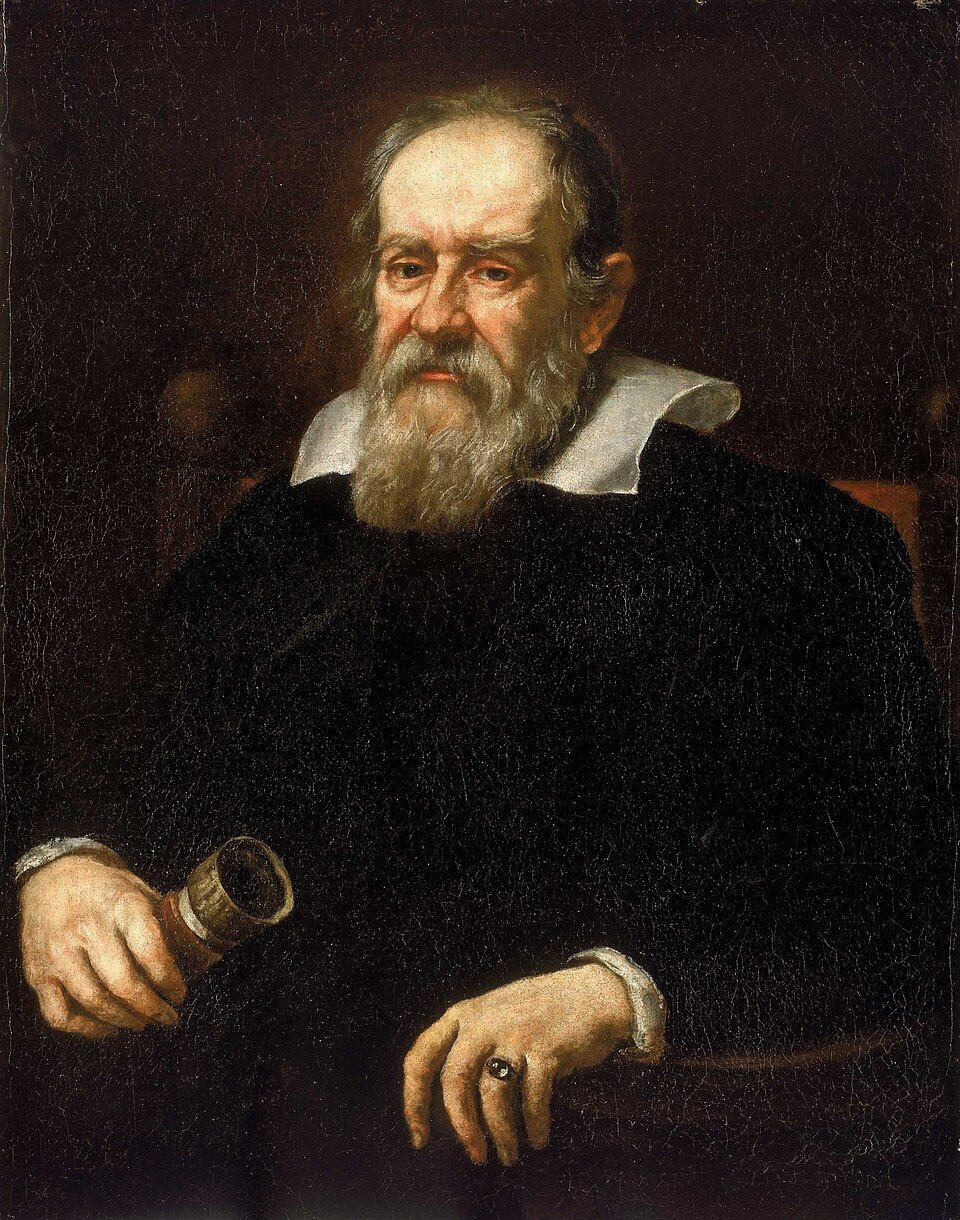
Who they were
He was born in Pisa in 1564, the son of a musician and music theorist, and gave up a medical degree for mathematics. He held the chair of mathematics at Pisa from 1589 and at Padua from 1592, where he spent the eighteen years he later called the happiest of his life, before returning to Florence in 1610 as mathematician and philosopher to the Medici grand duke. He never married; his elder daughter, who entered a convent as Sister Maria Celeste, wrote him the letters that survive as the closest record of his household. He died at Arcetri, outside Florence, in 1642.
What they did
He improved the telescope and observed the moons of Jupiter, the phases of Venus, and lunar craters, supporting Copernican heliocentrism; his advocacy led the Roman Inquisition to try him in 1633, forcing him to recant and spend his last years under house arrest. He also advanced the study of motion.
Legacy
Often called the father of modern observational astronomy and of modern physics, he became a symbol of the conflict between science and dogma, and the Church acknowledged errors in his condemnation only centuries later.