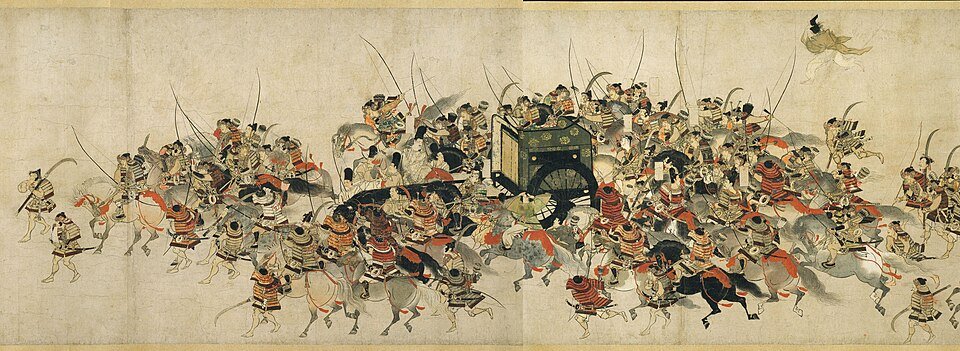
Overview
Power moved from the Heian court to a warrior government at Kamakura, and dress followed it. The extravagantly layered court wardrobe gave way to clothing that a man could ride and fight in, and the garment that would eventually become the kimono took another step out from underneath.
Key garments and style
Samurai dress is the hitatare: a wide-sleeved jacket and matching hakama cut from the same cloth, tied with cords rather than a sash, worn under armour or on its own. It began as commoners’ clothing and rose with the class that adopted it, which is the opposite of the usual direction.
Armour of the period, the ō-yoroi, was built as a box around a mounted archer, laced from small plates in silk cord whose colours were themselves a display.
Women shed the heaviest court layers. The jūnihitoe survived for ceremony, but the kosode — until now an undergarment — was increasingly worn as visible outer clothing, sometimes with hakama or with an outer robe over it. The decisive step is that the kosode’s surface starts to be worth decorating.
The period’s Buddhist revival also put plain monastic robes into ordinary view, and an austere taste ran alongside warrior practicality.
Transition
Under the Muromachi shoguns the kosode completed the journey, becoming the principal outer garment for every class and the direct ancestor of the kimono.