Overview
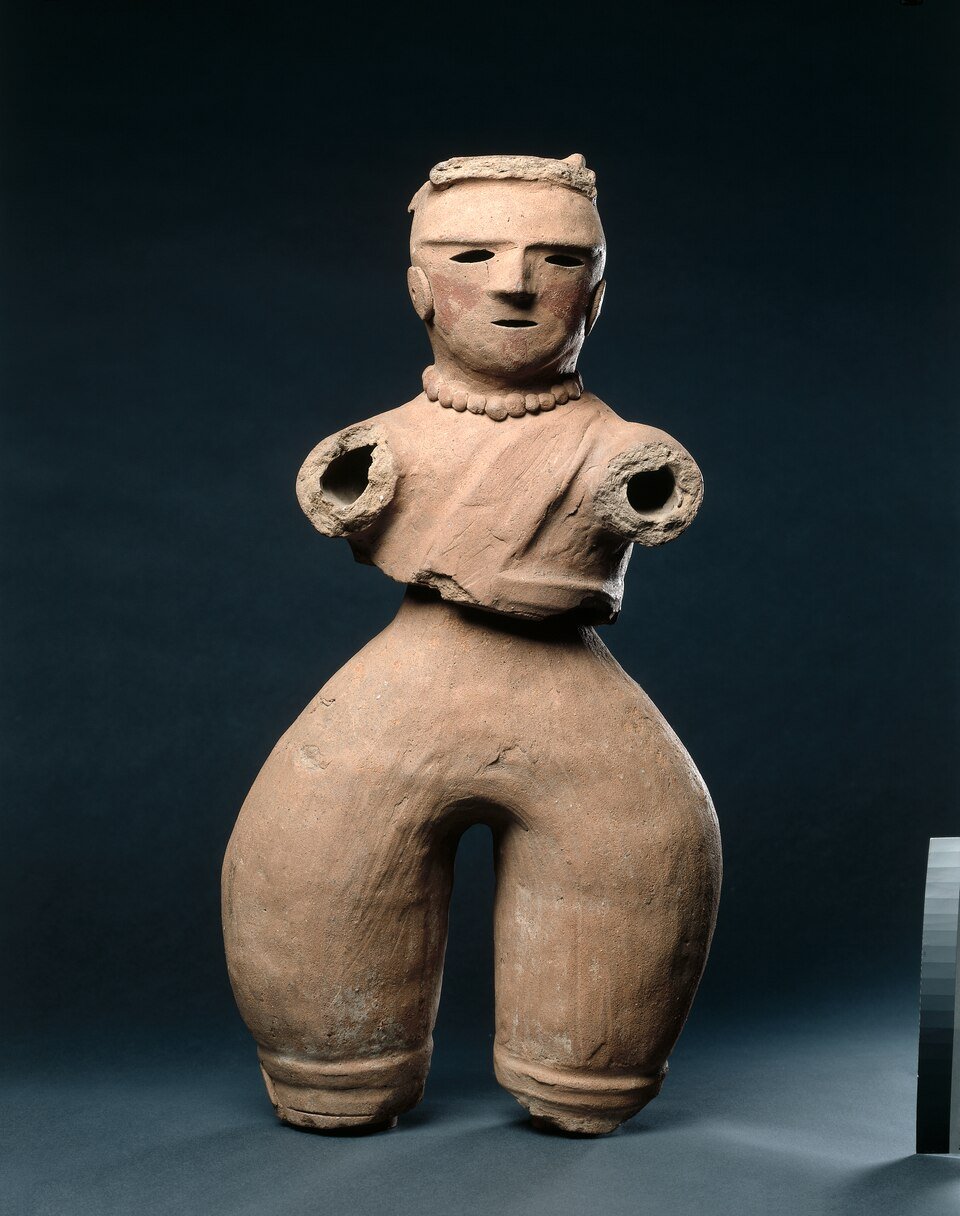
The unsewn Yayoi garment gives way here to clothes cut and sewn to shape. The upper garment, the kinu, is a jacket with sleeves, crossed over the chest and fastened with ties rather than buttons. Below it men wore hakama, wide trousers bound below the knee, and women wore mo, a long skirt worked in vertical pleats. The set is a two-piece, and the two pieces are the point: it is the first Japanese dress that has to be constructed rather than wrapped. It is known mainly from haniwa, the fired clay figures set on the great tombs the period is named for, which were modelled with unusual care at the collar, the cuff and the hem.
How it is worn
The jacket goes on like a coat and is held shut by cords sewn to the front edges, then bound again by a sash at the waist; nothing fastens through the cloth. Men’s trousers are wide to the knee and then tied close along the calf with a cord — a riding cut, worn by people who had just acquired the horse. Women’s skirts are wrapped and tied at the waist over the jacket’s hem and fall to the instep. Sleeve openings are finished with a band in a contrasting colour, which is the detail the clay figures take most trouble over. Over all of it went the ornament the tombs are full of: necklaces strung with the curved jade beads called magatama, bracelets at the wrist, and a headband or a cap sitting high on the crown.
History
The cut arrives with the same wave of contact that brought horse harness, iron working and the potter’s wheel across from the peninsula in the fourth and fifth centuries. It does not stop at the end of the period. Asuka and Nara court dress is this two-piece reworked under Chinese influence and then written into law, and the jacket-over-skirt of the Takamatsuzuka murals is recognisably its descendant.