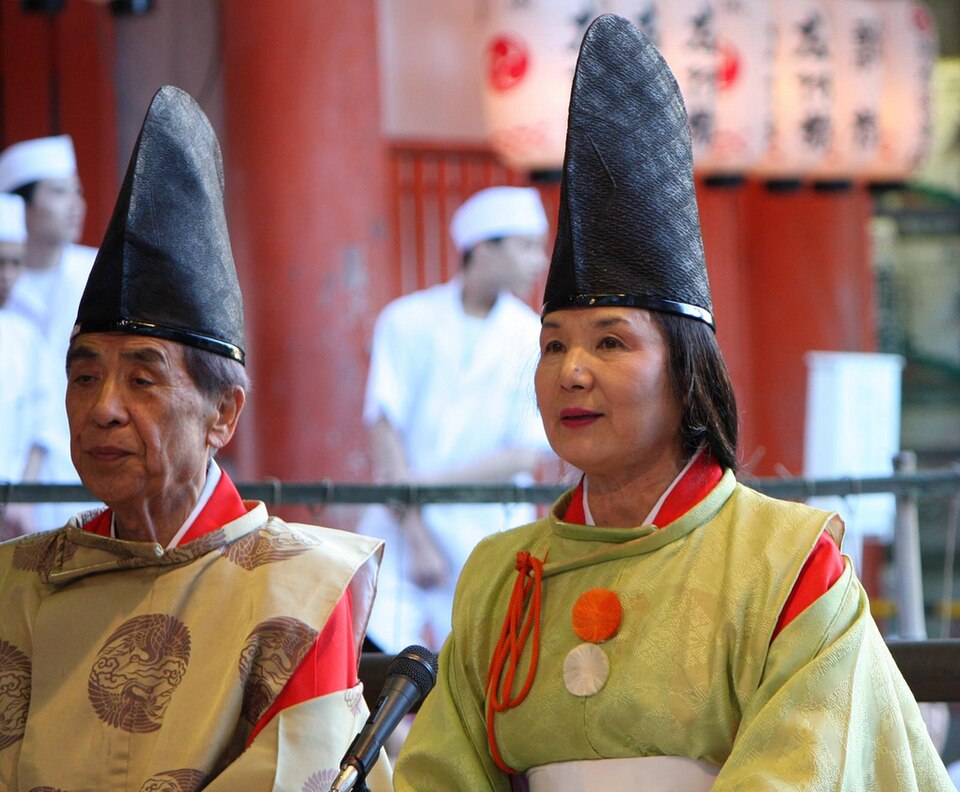
Overview
It is made by lacquering silk gauze or paper over a form until it holds its shape, then blackening it. The court version, the tate-eboshi, stands upright and tall; the folded ori-eboshi is creased over to one side and belongs with armour; the soft nashiuchi is pressed flat under a helmet. Height and stiffness track formality, and a warrior’s, a courtier’s and a townsman’s caps are different objects with the same name.
How it is worn
The hair is bound into a topknot first and the cap is set over it, then held by a cord under the chin or by a pin driven through the cap into the knot — the topknot anchors it, so the cap does not need to grip the skull. That dependence is the reason cutting a man’s topknot was an assault on his standing and not only on his hair: without it the cap will not sit. Indoors, at court, it stayed on.
History
The eboshi is the informal counterpart of the kanmuri, the formal court cap, and by the Heian period it had become what men wore in all situations that were not ceremonial. It spread downward through the medieval centuries — plain black for townsmen, folded for soldiers — and then thinned out with the Edo topknot styles and the Meiji haircut that ended them. It survives in Shinto priestly dress, in kagura and noh, and in the folded form worn with armour in period display.