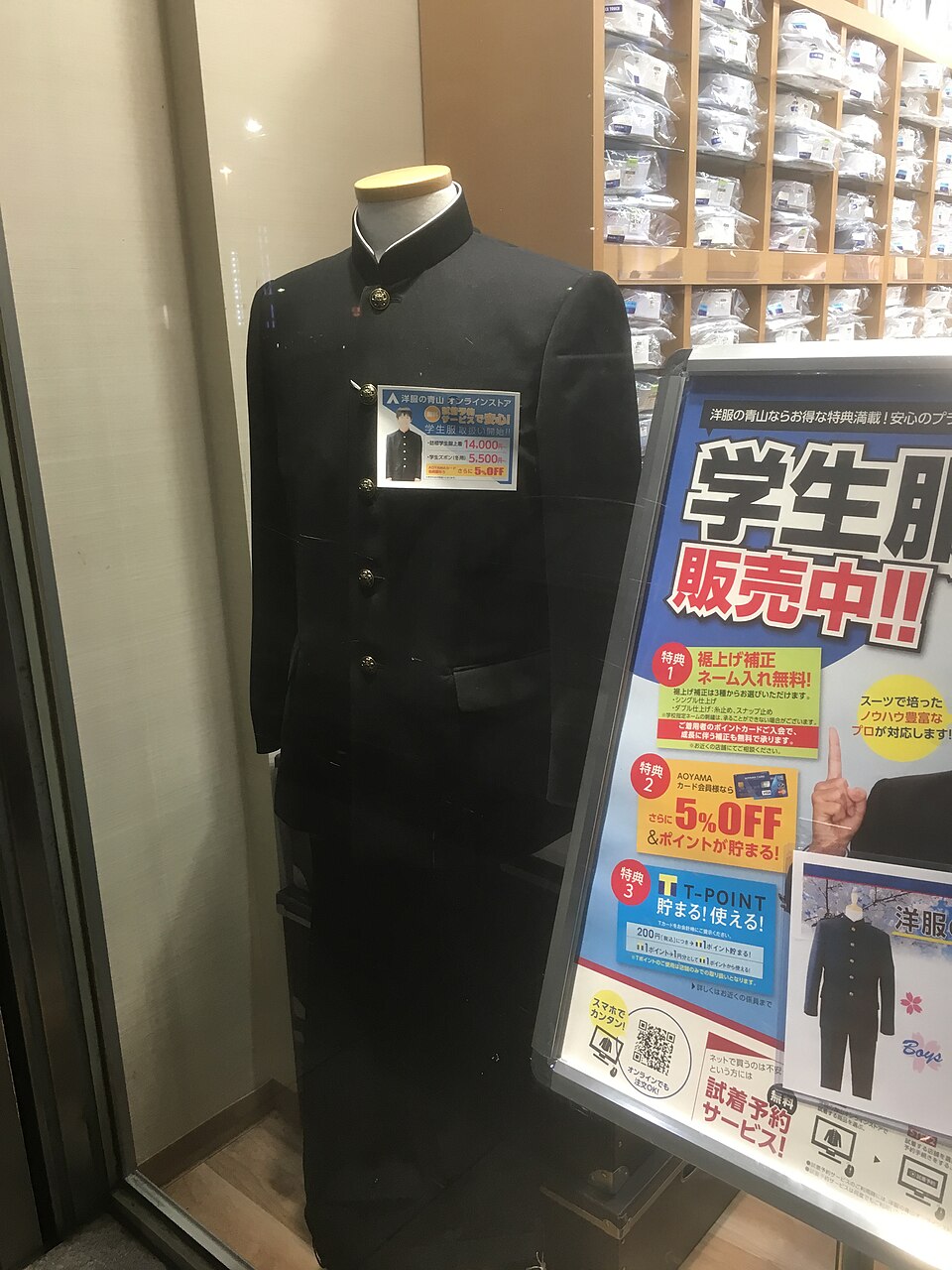
Overview
The jacket is black or very dark navy wool, single-breasted with five to seven metal buttons up the front, and a standing collar closed with hooks; a white plastic liner is inserted inside the collar and washed separately. School and year are shown by badges on the collar tabs, and the trousers match the jacket without a crease being required. It is worn with a white shirt or a round-necked undershirt, and nothing about it varies by fashion.
How it is worn
It is buttoned all the way up, including the collar hooks, which is the rule that generates most of the arguments about it. The second button from the top is the one a graduating boy is asked for by someone who likes him, because it sits over the heart — a custom strong enough that schools have had to rule on it. Wearing it open, or with the collar liner missing, is the standard small rebellion, and is read exactly as intended.
History
Japan adopted Western uniforms for its army and then its schools in the Meiji period, and Tokyo Imperial University put its students in a stand-collar jacket in 1886; the middle schools followed within a decade. The name joins gaku, study, to ran, the old word for Dutch and by extension Western. Blazers have taken perhaps half the country’s schools since the 1980s, and the gakuran survives as the traditional choice rather than the default one.