Overview
The clothes themselves are continental in cut, drawn from Sui and Tang China by way of the Korean kingdoms, and the court adopted them along with the writing, the law codes and the Buddhism that came in the same traffic. The most important change is not a garment but an idea: that dress should be regulated. From 603 the twelve-cap rank system assigned each grade of official a cap of a fixed silk colour, so that a man’s standing could be read across a room. Rank had been shown before by what a family could afford; now it was shown by what the court permitted.
How it is worn
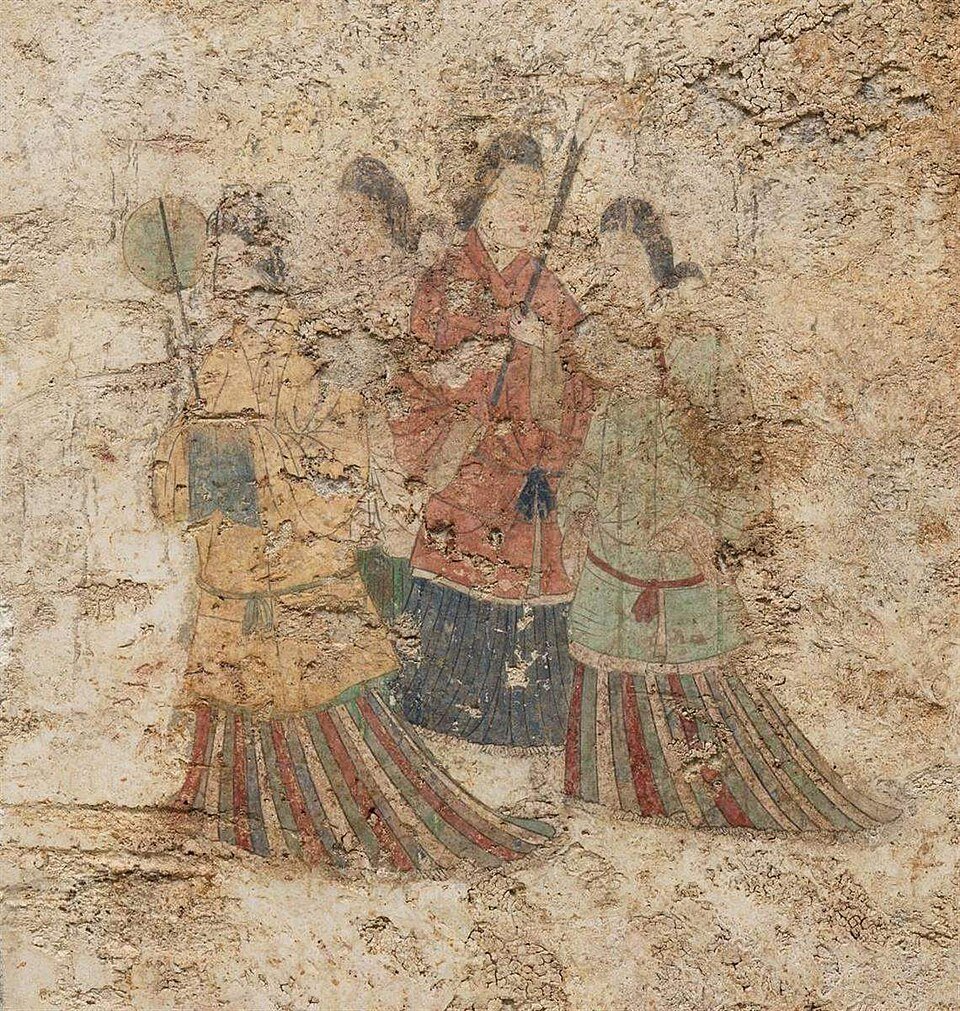
The jacket crosses at the front, stops at the hip and is held by a narrow sash; below it the skirt is wrapped and tied at the waist, worked in vertical pleats, and long enough to trail behind. A scarf hangs from the shoulders over both arms. Men wore the matching jacket over loose trousers gathered at the ankle, and at court a silk cap over it that stated the wearer’s rank. The west wall of the Takamatsuzuka Tomb, painted at the very end of the period, shows a group of women dressed exactly so, their skirts striped in red, green and white — and the pleating is the detail that dates the picture, being a Korean and Chinese fashion of the seventh century rather than anything native.
History
Asuka dress was codified rather than invented, and the codifying continued after it. The Nara court replaced the twelve caps with a fuller clothing code that graded dress into ceremonial, court and working orders, and the loose continental cut gradually gave way to the wider sleeves and higher waists of the eighth century. What survives from Asuka is the principle that the court, not the wearer, decides what may be worn.