Overview
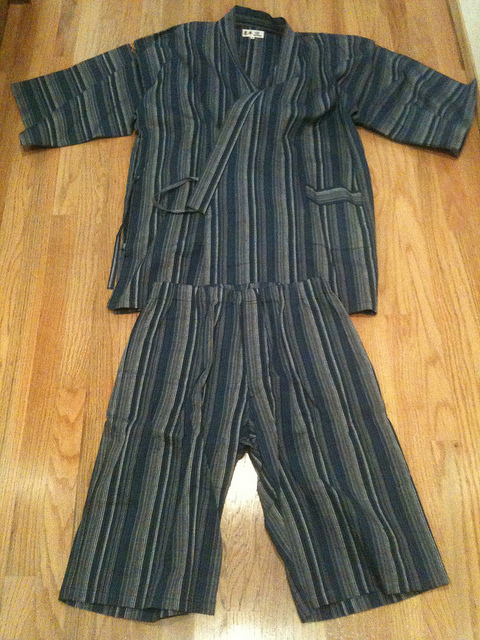
The top is cut like a short kimono with a sewn-on collar, fastened by cords at the side seams rather than by an obi, and the sleeves are stitched to the body only partly so air moves through the underarm. Sides and shoulders are often finished with an open lattice of thread, the tanzen-gumi, which is decorative and also a vent. The cloth is loose-woven cotton or a cotton-hemp mix, and the trousers stop above the knee.
How it is worn
It goes on over bare skin or a vest, left side over right like any kimono, with the inner cord tied inside and the outer cord at the hip. Nothing is layered under it and nothing is tucked, which is the whole design: it is worn to be loose. Men and boys wear it most, women’s versions have appeared since the 1990s, and it is acceptable outdoors at a festival and at a fireworks night but not much further.
History
It descends from the jinbaori-derived sleeveless house coat of the Edo period, and takes its present two-piece form in the Showa era, when the shorts were added and the set became summer home wear for men. Air conditioning did not kill it; it became the thing worn instead of air conditioning, and then the thing worn while the air conditioning runs. Its festival use is recent enough that older Japanese still read a jinbei on the street as pyjamas.