Overview
Mesoamerica in the Classic period dressed by rank, and did so explicitly. Among the Maya and at Teotihuacan, what a person wore recorded their standing, office and sometimes their name, and because so much of it was painted, carved and modelled, the system can be read in more detail than for most ancient societies.
Key garments and style
The fibres split by class. Cotton, grown in the lowlands and spun on the backstrap loom, was the elite material; commoners wore maguey and other agave fibres. Men wore the loincloth with a cape or hip-cloth; women the huipil, a straight tunic of joined woven panels, and in some regions the quechquemitl, a shoulder garment of two rectangles.
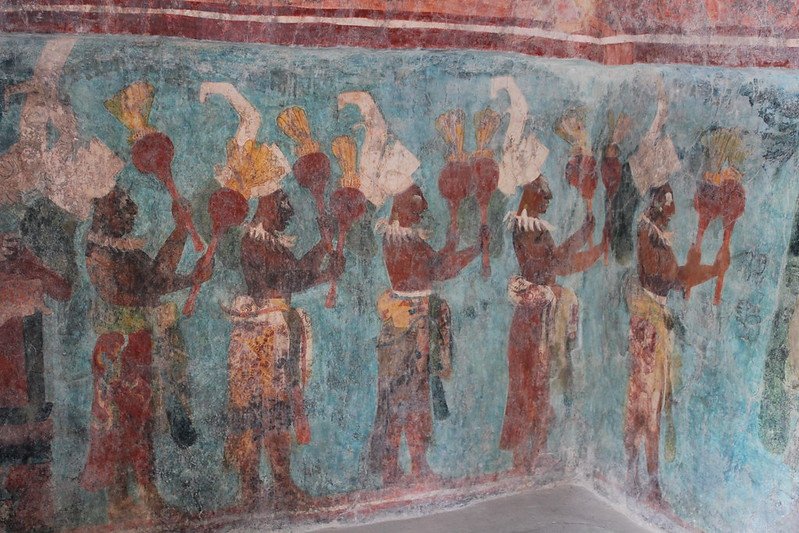
Elite dress was assembled rather than simply worn: enormous headdresses framed on light armatures and covered in quetzal and other feathers, jade collars, pectorals and ear-flares, jaguar pelt, shell and mosaic. The Bonampak murals are the fullest surviving record, and they show the apparatus in use — musicians, attendants and captives all dressed to their place in the scene.
The body was worked too. Cranial shaping in infancy, filed teeth inlaid with jade, tattooing and body paint were part of the same system, so appearance was not only what could be taken off.
Transition
The Postclassic states, and the Aztecs above all, turned these conventions into written sumptuary law, with cotton, feathers and specific ornaments restricted by rank and awarded for service.