Overview
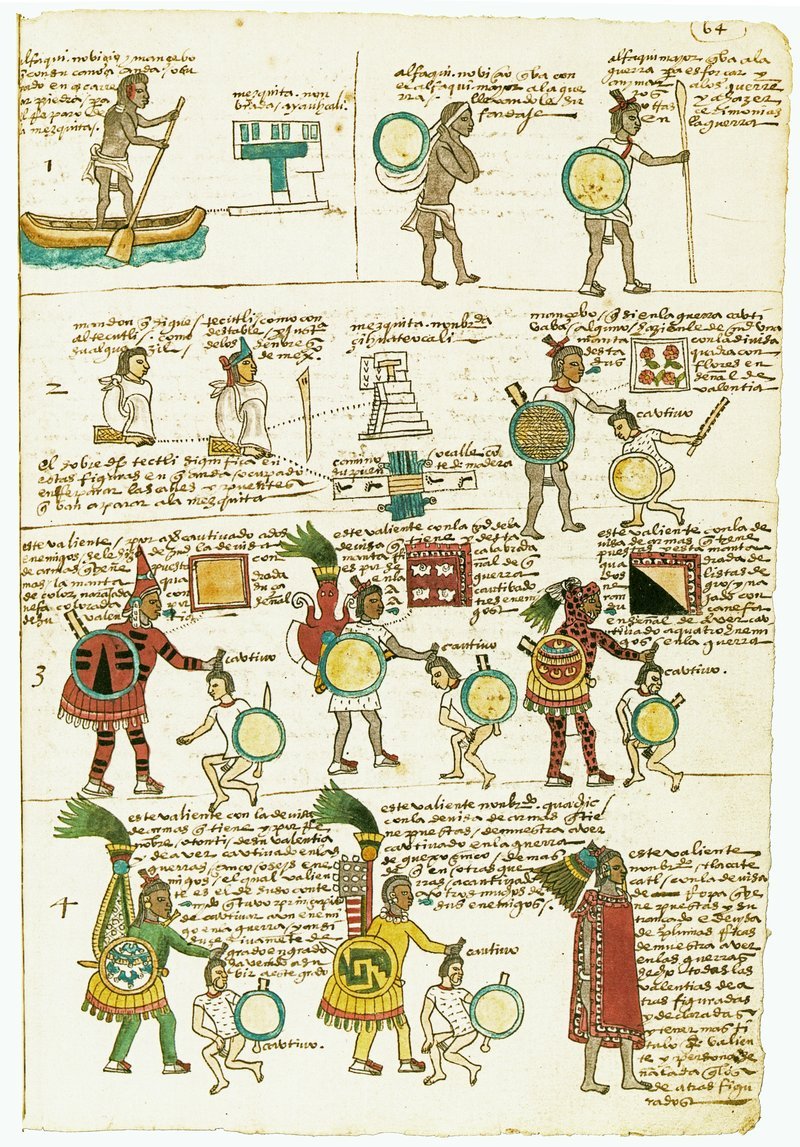
Aztec dress was regulated by law, in detail, with penalties. What a person could wear was set by birth and by deed, and the rules were specific enough that a Mexica could read rank, occupation and military record off a stranger in the street — clothing as a public register.
Key garments and style
The garments are the Mesoamerican standard: the maxtlatl loincloth and the tilmatli cloak, knotted at the shoulder, for men; the huipil and a wrapped skirt for women. The regulation is in the material and the finish. Commoners wore maguey fibre and their cloaks could not fall below the knee; cotton, long cloaks, sandals in the palace precinct, and specific ornaments in lip, ear and nose were reserved to nobles.
Some of it could be earned. Warriors advanced through grades marked by distinctive suits and cloak designs awarded for captives taken, so a man’s record was worn.
Featherwork was the luxury art, made by the amanteca from tropical feathers brought as tribute, with quetzal reserved for the highest ranks. To the north, other traditions ran in parallel: Mississippian towns with shell gorgets and copper, and Puebloan communities weaving cotton on upright looms.
Transition
The Spanish arrival broke the legal system that made this dress legible, and cotton, wool and Spanish forms entered a wardrobe whose rules no longer had a state behind them.