Overview
In the Andes the Spanish arrived in a society where cloth was the principal store of wealth and the main instrument of statecraft, and they did not understand that until they had destroyed a great deal of it. The conquest is therefore a textile event as much as a military one: what was seized, burned and forbidden was not incidental to Andean society but close to its centre.
Key garments and style
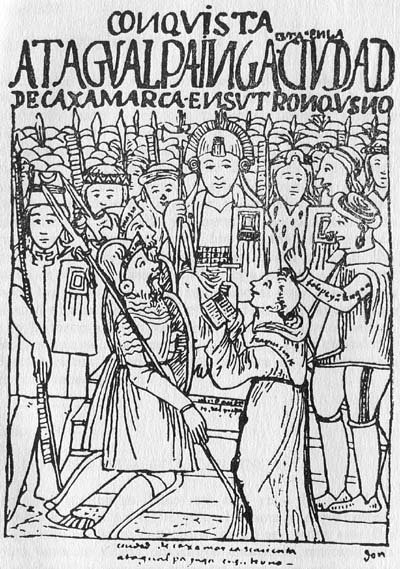
The Spanish came in doublet and hose, quilted or steel body armour and brimmed hats, dressed for a European campaign and conspicuously unsuited to the altitude.
Andean dress was the rectangular uncu tunic for men and the wrapped lliclla and anacu for women, pinned with the tupu, woven from cotton on the coast and alpaca and vicuña wool in the highlands. The Inca state ran vast cloth stores and issued garments as payment, reward and obligation; the finest cumbi tapestry was made by dedicated weavers and reserved by the ruler. Spanish accounts describe storehouses of cloth being burned, and vicuña herds, once protected by state hunt, were shot out.
Dress then became an instrument of colonial rule. After the Túpac Amaru rebellion of 1780 the authorities banned Inca noble dress along with the language of the theatre and the portraits, understanding by then exactly what clothing signified.
Transition
Under the colonial caste order, Andean dress absorbed Spanish elements — the montera hat, the gathered pollera skirt — into a hybrid that is now read as traditional Andean costume.