Overview
The Inca ran an empire on cloth. Textiles were the state’s principal store of value, its currency of obligation and its instrument of favour — accumulated in warehouses, issued as payment, given as reward and burned as offering. No other empire made clothing so directly an arm of government.
Key garments and style
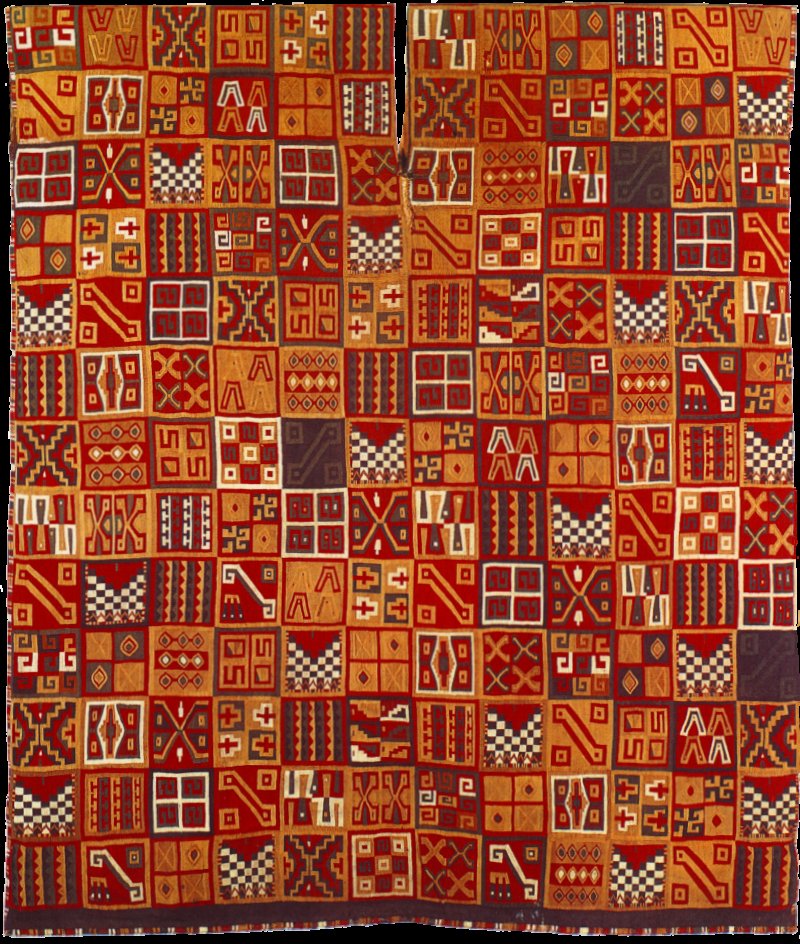
Men wore the unku, a rectangular tunic pulled over the head, with a loincloth and a mantle; women the aksu, a long cloth wrapped around the body and pinned at the shoulders with tupu, large metal pins with flattened heads, under a lliclla shawl also pinned at the chest.
Cloth was graded. Awasqa was the ordinary household weave; cumbi, tapestry of extraordinary fineness, was made by specialists — the aqllakuna women in state institutions, and male cumbicamayoc weavers — and was reserved to the ruler to wear and to give.
The decoration was administrative. Tocapu, small square geometric motifs arranged in bands or all over a tunic, encoded status and affiliation, and a tunic covered entirely in tocapu belonged to the very top of the hierarchy. Vicuña, the finest fibre in the world, was taken in state-controlled hunts.
Transition
The Spanish conquest broke the system that gave the cloth its meaning, and Andean weaving continued as a household and community tradition rather than a state one.