Overview
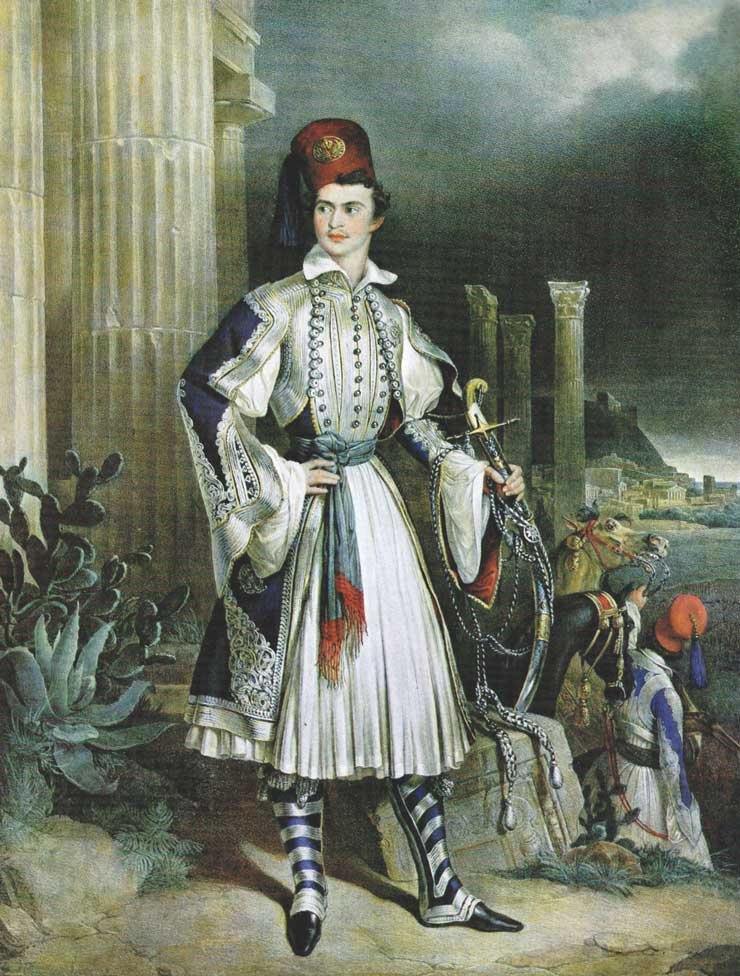
Independent Greece had to decide what Greeks looked like, and it chose a version of village dress over both Ottoman clothing and European tailoring. What had been the working costume of mainland districts was promoted into national dress within a generation — a deliberate act of nation-building, not a survival.
Key garments and style
The fustanella, the white pleated skirt worn with leggings, an embroidered waistcoat and a short jacket, had been the dress of klephts and armatoloi and became the dress of the state. King Otto wore it, and it was fixed as court dress; it survives now on the Evzones of the Presidential Guard, whose ceremonial version keeps the pleating and the pom-pom shoe.
The women’s counterpart was built rather than adopted. The Amalia dress, associated with Otto’s queen and taken up widely from the 1830s, combined a loose embroidered jacket over a long silk skirt with a soft cap — a romantic-national costume assembled from regional elements and worn by townswomen who had never worn any of them.
Everyday clothing meanwhile went European on the ordinary timetable, so by the later nineteenth century the national dress was already ceremonial.
Transition
Greek dress today is Western, with the fustanella and the regional costumes kept for guard duty, festivals and folk dance — worn to mean Greece rather than to be worn.