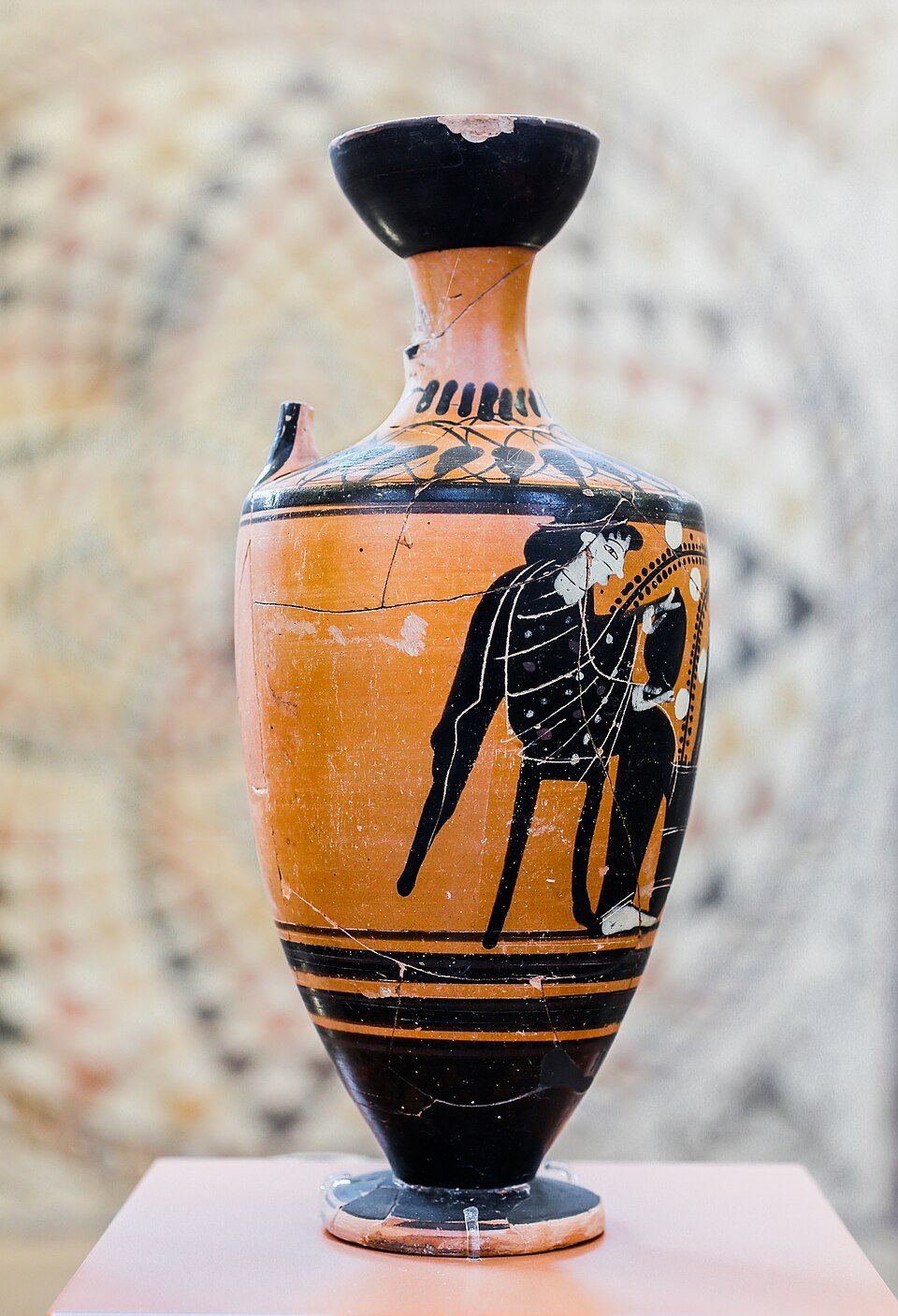
Overview
Archaic Greece is where Greek dress becomes Greek: a system built entirely from rectangles of cloth, held on the body by pins, buttons and a belt, with almost no cutting and very little sewing. It is the opposite of the fitted Bronze Age dress that preceded it, and its logic — the same flat cloth draped differently for men and women, rich and poor — lasted a thousand years.
Key garments and style
Two forms coexisted and competed. The Doric peplos is a single heavy woollen rectangle, folded over at the top, wrapped round the body and pinned at both shoulders, open down one side. The Ionic chiton is lighter, usually linen, wide enough to be fastened along the arms at intervals so that it falls in narrow pleats, and it gives the elaborately crimped drapery of the kore statues from the Athenian Acropolis. Over either went the himation, a mantle. Cloth was coloured and patterned at the borders, and traces of paint on sculpture confirm that the marble originals were nothing like white.
Herodotus tells a story about why the change happened: Athenian women, he says, were forbidden the pinned Doric dress after they used their pins to kill a messenger, and adopted the sewn Ionic form instead. It is a folk explanation for a real shift and worth knowing as that rather than as history.
Transition
Classical Greece kept both garments and simplified them, and the peplos returned to favour — the severe, plain woollen dress of fifth-century sculpture is a deliberate rejection of Archaic elaboration.