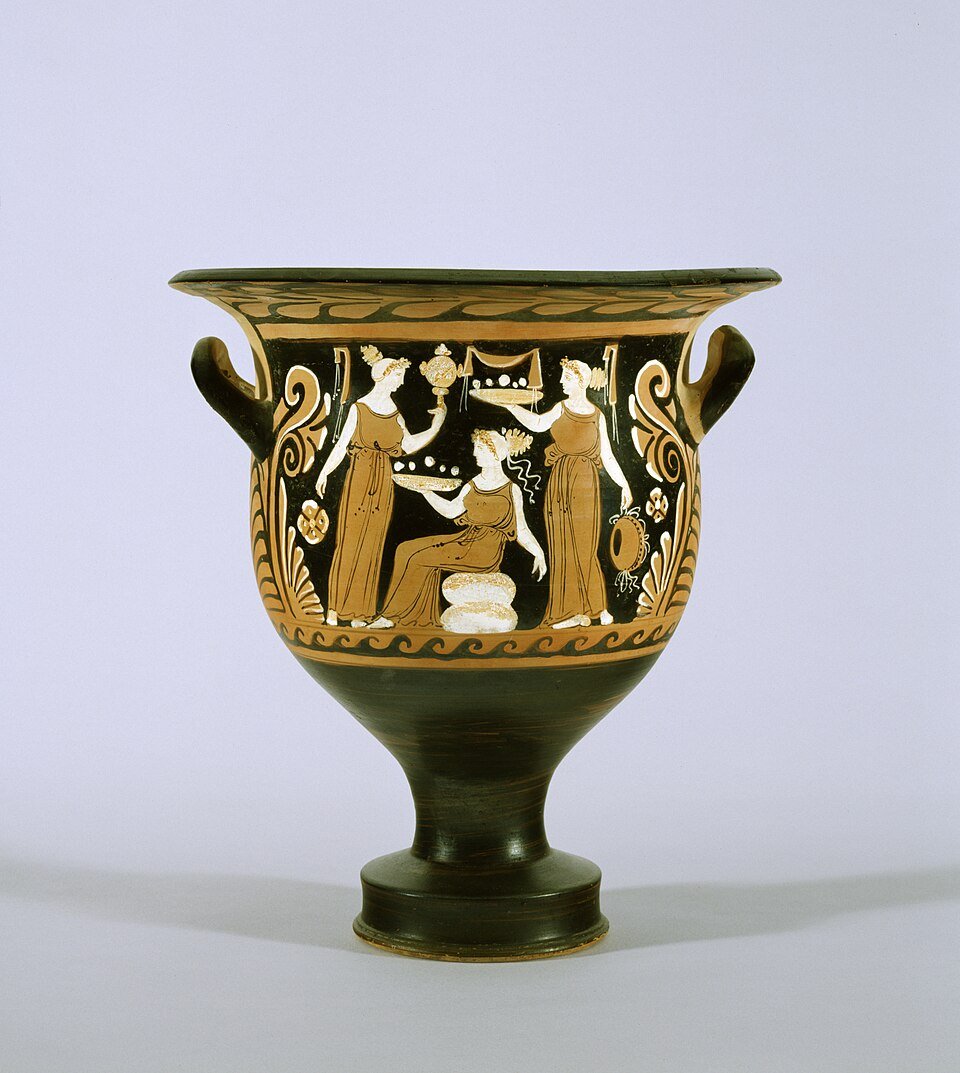
Overview
Classical Greek dress is a system with almost no tailoring in it. Everything is a rectangle of woven cloth, held on the body by pins, buttons and a belt, and the whole art is in the folding — which is why Greek sculpture is essentially a study of what cloth does when it hangs.
Key garments and style
The peplos is a single heavy woollen rectangle, folded over at the top, pinned at both shoulders and belted, open down one side. The chiton is lighter, usually linen, and wider: fastened at intervals along the arms so it falls in fine pleats, or sewn into sleeves. Over either goes the himation, a mantle wound about the body and often over the head. Men add the chlamys, a short cloak pinned at one shoulder for riding and travel, and the exomis, fastened at one shoulder only, for work.
Cloth was made at home, and weaving was the archetypal female occupation in Greek literature. It was also coloured: traces of pigment on sculpture, and the vases, show borders, bands and strong dyes, so the white marble impression is a modern accident.
How the garment was worn carried meaning — the depth of the overfold, whether the himation covered the head, whether the arms were free — and Greek writers moralise about it accordingly.
Transition
The Hellenistic age kept the same garments and elaborated the draping, with finer cloth and more complex arrangements spreading across the enlarged Greek world.