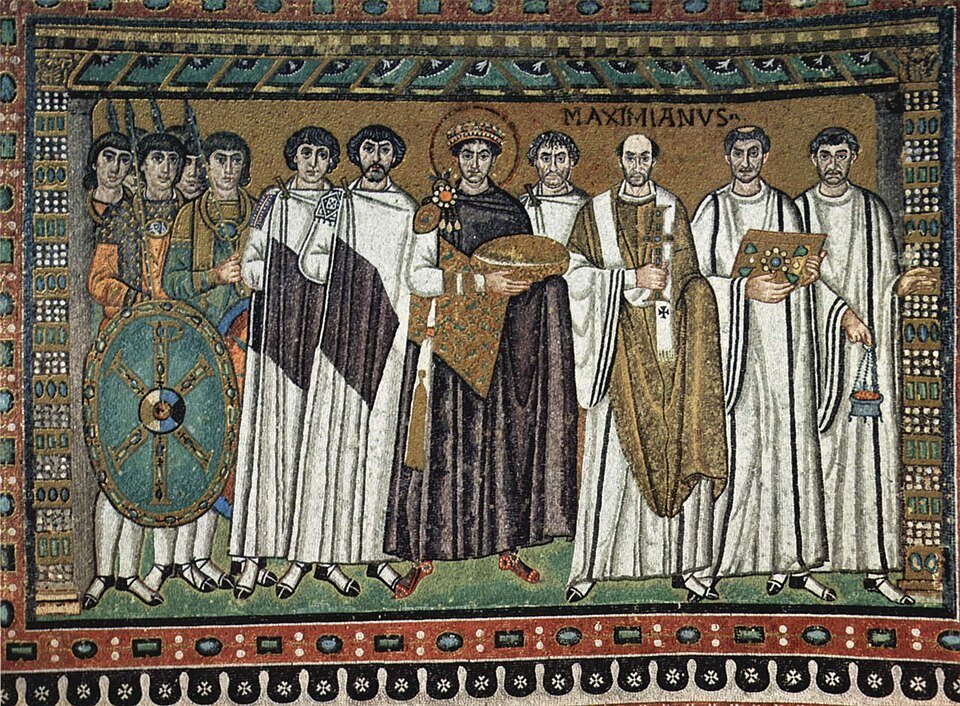
Overview
Byzantine dress is the point at which the classical world stops draping and starts tailoring. The himation and the toga give way to cut and sewn tunics and long covering robes, worn by everyone and elaborated upward through the ranks by material rather than by shape — and in Greece this was not only a matter of wearing silk but of making it.
Key garments and style
The basic garment is a long-sleeved tunic, worn under a wider over-tunic or the dalmatic, with a cloak fastened at the shoulder; the body is covered from neck to ankle for men and women alike, in keeping with Christian ideas of modesty. Rank is read from cloth and colour. The emperor and empress wore the loros, a long jewelled band wound about the body, and the tablion, a rectangular panel of contrasting silk set into the cloak, marked high office.
Purple was regulated as a state matter, with the deepest murex shades reserved to the imperial house — the reason a child born to a reigning emperor was called born in the purple.
Greece was a producing region, not just a consuming one. Thebes and Corinth were among the empire’s principal silk centres, and when the Normans raided them in 1147 they carried off the silk workers to Sicily, which is how a Greek industry seeded a Western one.
Transition
After 1453 Greek dress passed under Ottoman rule, and the long robe, the sash and the turban of the Ottoman world replaced Byzantine court forms in the towns.