Overview
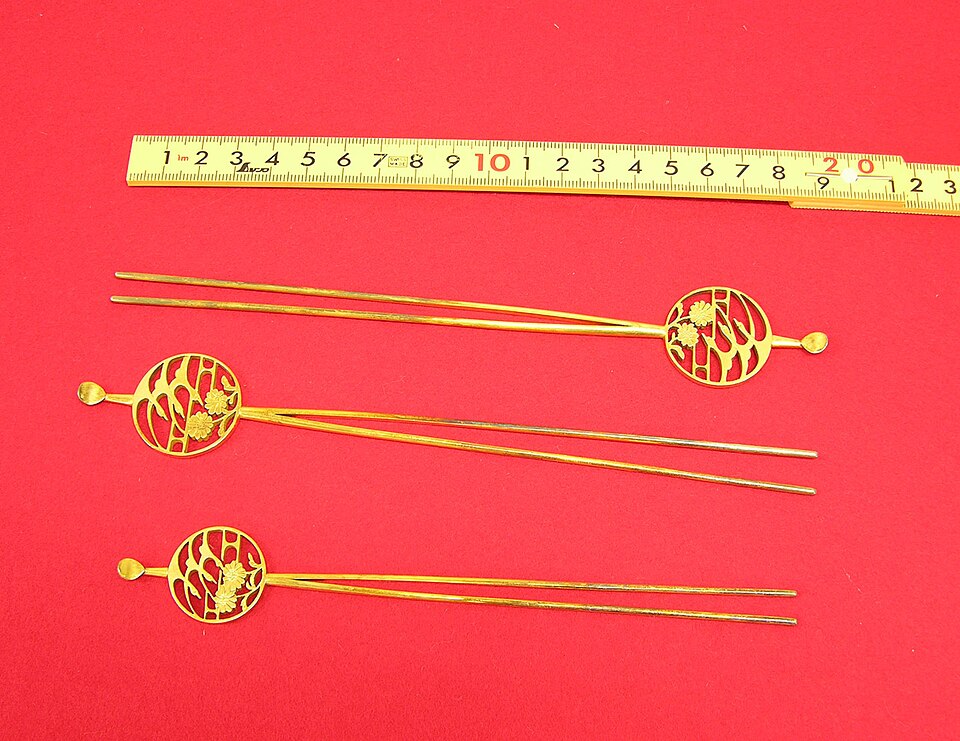
They are not one object but a family: a straight two-pronged pin that grips the knot, a flat spatulate one that slides under it, a long pin hung with a swinging ornament, a comb worn along the front of the coiffure, and the tsumami form in which small squares of silk are folded into petals and mounted on a wire spray. The material carried the meaning — tortoiseshell for a wealthy household, silver for a formal occasion, painted wood for a girl — and the seasonal flower on a tsumami piece changed month by month.
How it is worn
The hair is dressed first, oiled and bound into loops and a knot, and the pins are pushed into the binding so the hair holds them rather than the reverse; a spray sits at the side above the ear, a comb along the front edge, and the swinging piece where it will move. Nothing is glued or clipped. Because the coiffure is built to take them, the whole arrangement comes down as a unit, and the pins are removed in reverse order.
History
Edo hairdressing grew steadily more elaborate over two centuries and the pin trade grew with it, into shops that sold nothing else and craftsmen who worked in a single material. Sumptuary edicts repeatedly restricted tortoiseshell and silver, and were repeatedly evaded. The style survives where the coiffure does — in the dress of maiko and geiko, whose monthly flowers are still made by the folded-silk method, and in the sets worn with formal kimono at weddings and coming-of-age ceremonies.