Overview
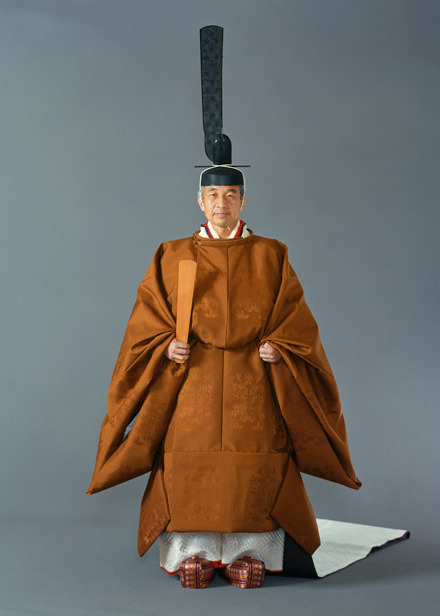
The visible garment is the ho, a long outer robe whose colour is set by rank — black for the highest, then red, and green below — worn over the shitagasane, whose train, the kyo, trails behind. A leather belt with stone or jade plaques marks the waist, the kanmuri cap sits on the head with its tail behind, and the right hand holds the shaku, a flat baton of wood or ivory. Beneath it all are the sashinuki or the stiffer okuchi trousers.
How it is worn
Everything is put on in order and nothing is adjusted afterwards: the layers are aligned at the neck so each shows as a band, the belt is set high enough to blouse the robe over it, and the train is arranged behind by an attendant. The shaku is held vertically at the chest with both hands or one, and the sleeves are kept forward. It is heavy, hot and slow to move in, and the slowness is the point.
History
The sokutai settles into shape in the Heian period out of Tang-influenced court dress, and the Japanese court then stopped changing it, so what is worn at an enthronement now is recognisably the tenth-century garment. Rank colours were revised, the train was shortened for lesser occasions, and the ikan — the same outfit without the train — became the working version. Its survival is the same story as the kariginu’s: ritual freezes what daily life would have discarded.